Speech and voice creation
Turn scripts into speech with library voices, designed voices, or authorized voice clones. Model, language, voice, and settings affect expression, stability, speed, and consistency.
O07O09O10O15A strong tool to audition for pre-generated game dialogue and hard-to-source sound effects—provided you budget for retries and manage voice rights deliberately.
PRODUCT OVERVIEW
ElevenLabs is a cloud AI-audio platform for creating, editing, and deploying generated speech and sound. Its no-code ElevenCreative workspace brings together text-to-speech, voice selection and creation, dubbing, sound effects, music, and multitrack production in Studio. Developers can use the REST API and official Python or TypeScript SDKs, while ElevenAgents is the separate path for interactive voice experiences.
For a game team, a typical offline workflow starts with a script or sound prompt: choose or create a voice, select a model and language, generate several takes, correct pronunciation or timing, approve the asset, and export it into the game-audio pipeline. Sound Effects creates prompt-based effects with duration and looping controls; Dubbing localizes existing audio or video; Studio assembles narration, captions, music, and effects on a timeline.
Use the browser workspace for manual production and review; use the API or SDKs for repeatable pipelines and product integration. Both paths draw on account plans, credits, and service-specific rules.
Turn scripts into speech with library voices, designed voices, or authorized voice clones. Model, language, voice, and settings affect expression, stability, speed, and consistency.
O07O09O10O15Generate sound effects from text with duration and loop controls, then download or call them through the API. ElevenCreative also includes music generation, which this review names for completeness but does not assess.
O08O13Localize existing audio or video with Dubbing, including multi-speaker editing. Studio provides a timeline for video, captions, narration, music, and effects, with collaboration and audio or video export.
O14O16Automate generation through ElevenAPI and official Python or TypeScript SDKs. ElevenAgents and the official Unity package extend the platform toward interactive voice, but runtime behavior remains a separate engineering decision.
O11O15INTERFACE & EXAMPLES
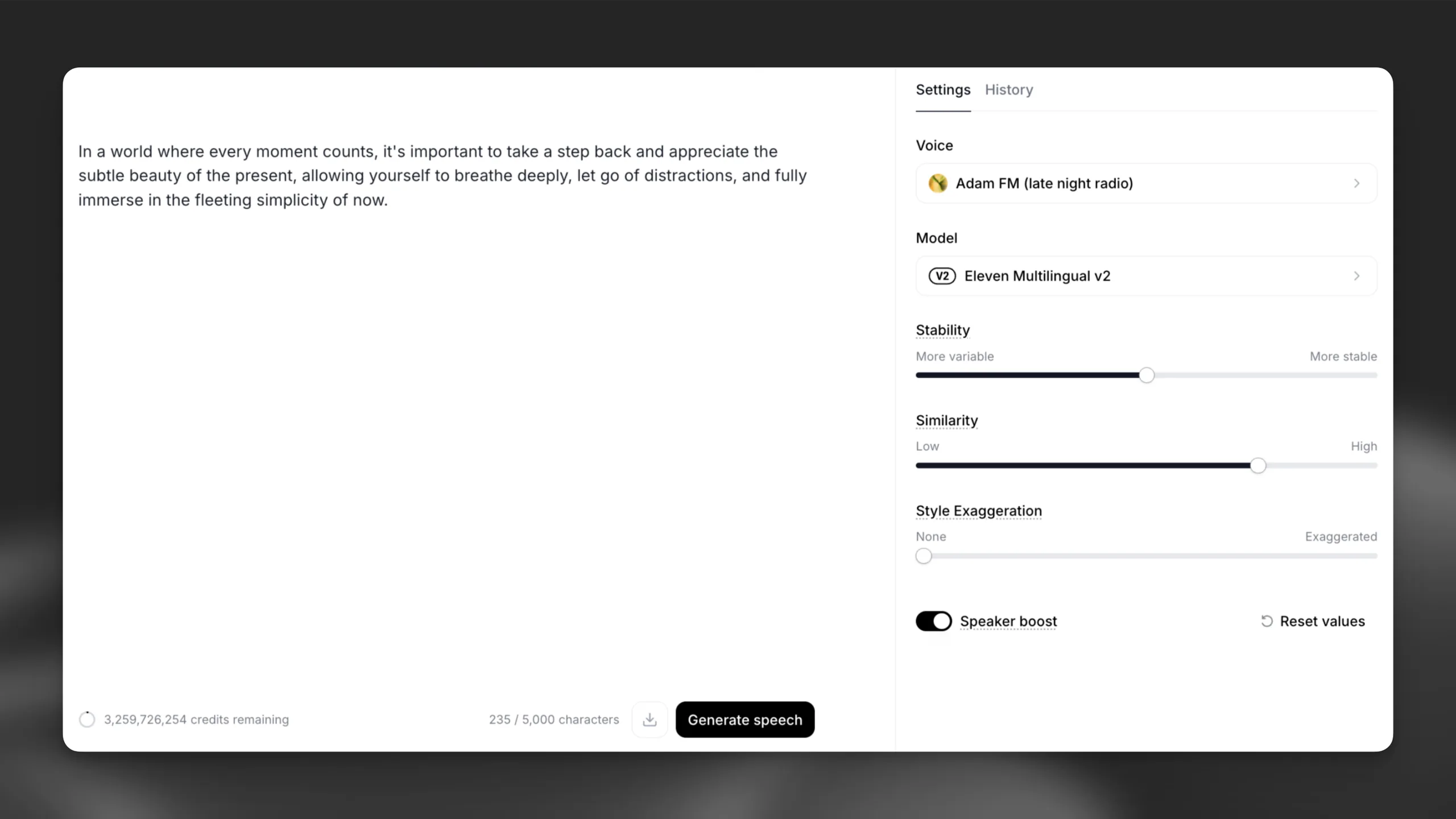
The official Text to Speech guide shows the script box alongside voice, model, and generation settings.
The description above maps the wider product. The evaluation below is narrower: pre-generated game dialogue, character voices, custom SFX, and dubbing. Music, full Studio production performance, and interactive Agents are described for context but not scored or recommended here.
Beginner scope: Pre-generated dialogue and individual sound effects in the web app.
Agent scope: Generate and save game audio assets, not a complete realtime NPC system.
Confidence: learning Medium · Agent Medium
These are independent editorial judgments, not an overall score or a claim of hands-on agent integration testing.
KEY FINDINGS
Several recent game cases reached usable or well-received dialogue, but their workflows included prompting, stability tuning, short clips, selection among takes, reverb, or other finishing. The evidence supports production potential—not one-click reliability.
U01U02U07U10Official guidance positions v3 for expressive delivery and Multilingual v2 for stable long-form work. Multiple users report drift or audible changes when long scripts are split into clips. Test the actual voice, language, names, and scene length before committing a full script.
O07U02U03U04U08U10The public plan price is easy to read, but the shared credit pool is consumed by generations across products. Pronunciation fixes, direction changes, and failed takes can materially change cost; estimate with a representative scene and record first-pass acceptance before scaling.
O02U01U04U05U09U10U11The product can generate short, loopable effects, and public game cases show it can reach shipped projects. Independent tests suggest simple, specific prompts are safer than asking one generation to combine many events. Libraries and sound-design tools remain useful alternatives.
O08U06U11U12U13EDITORIAL VERDICT
ElevenLabs belongs on the shortlist when a developer needs expressive speech quickly and can keep a human in the loop for casting, direction, line-by-line review, and audio finishing. The evidence is less convincing for deterministic long-form delivery or high-volume real-time dialogue: consistency, credit use, latency, and engine behavior become project-specific. Treat it as an audio production system, not a one-click substitute for voice direction or sound design.
BETTER FIT
POORER FIT
WORKFLOW FIT
Audition voices on a small set of emotionally different lines, then generate scene-sized batches and review every line in context.
Use generation when a library search cannot express the event, texture, perspective, or loop you need; keep variants and layer them in a DAW when useful.
Generate localized candidates, then use a native reviewer for meaning, names, timing, accent, and cultural fit before integration.
RECOMMENDED WORKFLOW
Start from a testable brief, then move through prototyping, assets, audio, testing, and release with an explicit handoff and human check at every step.
SHORTEST RESPONSIBLE PATH
This is a low-risk starting workflow synthesized from the evidence.
Choose three representative scenes: neutral exposition, emotional dialogue, and names or invented terms.
Compare an expressive model with the more stable long-form option using the same voice and text.
Record credits, generations, accepted first takes, pronunciation fixes, and time spent—not just the subscription price.
Finish selected audio in context: pacing, loudness, cleanup, reverb, file naming, and engine import.
Before commercial use, confirm the paid plan, voice consent and provenance, current service terms, privacy settings, and any disclosure obligations.
PRICING & RIGHTS
Pricing and terms last checked: Aug 20, 2026
ElevenLabs says free-plan output is non-commercial and requires attribution when shared. Paid plans include commercial use if you hold the necessary rights and comply with applicable law, the general terms, prohibited-use policy, and service-specific terms. Beta Services output cannot be used commercially or in production under the current help guidance.
Prices and terms are volatile. Verify the linked official pages again on the day you subscribe or ship; this page is editorial information, not legal advice.
PRODUCTION RISKS
Community Voice Library entries can carry plan restrictions or credit multipliers and can be removed. A production should keep source, permission, fallback, and replacement records rather than assuming a community voice is permanent.
O09Professional cloning follows a voice-owner verification flow, and harmful or deceptive impersonation is prohibited. Obtain permission, retain provenance, and do not treat technical access as permission to use a person's voice.
O10O12The privacy policy describes processing audio, text, metadata, and voice data—including possible biometric data—and discusses AI research or training uses and account controls. Review it before uploading actor recordings, unreleased scripts, or sensitive material.
O06The official Unity agents SDK is currently labeled early-stage, and direct client-side integrations can expose secrets. Use a server-side boundary where appropriate and validate platform compatibility, latency, concurrency, failure handling, and cost in the actual game.
O11U14Some public game examples received positive reactions, while broader game-development discussions include strong objections. Quality, consent, disclosure, genre, and community norms all affect reception; there is no defensible universal acceptance rate in the reviewed evidence.
U01U05U07NOT VERIFIED
RESEARCH METHOD
Research-reviewed from public evidence. We checked 16 official sources and coded 14 independent records across five source types. Recent, task-specific game cases received more weight than generic ratings; 2024 SFX material is historical context only. We grouped recurring observations by workflow, looked for counterexamples, did not average platform stars, and stopped when additional sources repeated existing themes. Overall confidence is medium because product facts are well documented but output quality and runtime fit remain project-dependent.
Official scope for game dialogue, voices, sound effects, dubbing, and API use.
Current self-serve plans, shared credits, product metering, and rollover rules.
Free-plan, paid-plan, attribution, commercial-use, and Beta Services conditions.
General rights, responsibilities, content terms, and regional applicability.
Additional terms that can differ by speech, sound-effects, music, and other services.
Data categories, voice data, AI research and training, controls, and retention context.
Model tradeoffs, nondeterminism, voice selection, formats, and generation limits.
Text-to-sound-effects scope, duration, looping, prompting, and API behavior.
Community voice availability, plan restrictions, multipliers, and removal behavior.
Professional Voice Clones are tied to the voice owner's own verification and sharing flow.
Official Unity package; its repository currently labels the SDK early-stage and subject to API changes.
Restrictions covering harmful impersonation, deceptive use, and other prohibited activity.
Official overview of the browser-based creative workspace and its speech, dubbing, music, sound-design, and voice tools.
Studio timeline, tracks, collaboration, and audio/video export workflow.
Current product map for ElevenCreative, ElevenAPI, ElevenAgents, voices, models, credits, and official SDKs.
Official description of dubbing, speaker handling, localization, editing, and export capabilities.
A released-game case reporting roughly 45,000 credits, substantial direction, and some post-processing; comments also surface long-clip consistency limits.
A game developer reports accent drift on longer lines and uses short chunks, repeated prompting, and stability tuning.
A creator reports audible voice changes between one-minute clips; the discussion distinguishes v2 consistency from v3 expressiveness.
A long-form user reports cuts, pops, timbre changes, and expensive retries; replies steer consistency-sensitive work toward v2.
A current game-development discussion highlights unpredictable dynamic-voice cost and sharply divided acceptance of generated voice work.
A live browser-game case says ElevenLabs supplied lobby music, between-round music, and many sound effects; production detail is limited.
A game clip receives mostly favorable small-sample feedback, while comments show that reverb and presentation can materially shape perception.
A production workflow reports that consistency across scenes, narrators, and large scripts is harder than basic voice quality.
A large, mixed consumer-review corpus: praise clusters around capability and ease, while complaints cluster around credits, billing, consistency, and support. Platform selection bias remains substantial.
Four stock voices were run on the same 991-character script with raw first takes and measured generation times. The publisher discloses affiliate commissions.
A live-account walkthrough tracks TTS and SFX credit use and feature access. It contains affiliate links, and some interface figures changed between retests.
An older hands-on test finds simple prompts more reliable than layered requests. It is retained only as historical SFX context.
A game-audio educator compares generated SFX with recording, libraries, and dedicated sound-design tools. Used as historical workflow context, not current product proof.
A maintained third-party Unity client demonstrates integration demand and warns that direct front-end use can expose API keys.
DISCLOSURE
Independent editorial research. MakeGameWithAI has no affiliate link, sponsorship, vendor-provided account, free credits, equipment, or technical support for this review. Some third-party sources disclose their own affiliate relationships; they were treated as supporting evidence, never as sole support. Owner Review was completed before publication.
This public research review will be revisited when pricing, terms, product versions, or material new evidence changes.