Editor-to-repository coding
Use completions for local patterns, then Chat, Plan, or Agent for repository search, multi-file edits, commands, tests, and review. Each surface has different permissions and credit behavior.
O01O02O07O19A GitHub-native coding-agent platform for turning small game ideas into reviewable, playable changes.
PRODUCT OVERVIEW
GitHub Copilot is an AI coding assistant and agent platform across supported editors, GitHub, the command line, and a desktop app. It can complete code, explain a repository, plan work, edit multiple files, run tools, work asynchronously on issues, open pull requests, and review changes.
Its surfaces serve different jobs. Inline suggestions and next edit accelerate local typing; Chat, Plan, and Agent modes handle bounded implementation; Copilot CLI works from a terminal; the cloud agent runs in an ephemeral GitHub Actions environment; code review provides another review pass. A generally available SDK and a programmatic CLI also let another application send work and retrieve results, while ACP adds a public-preview protocol route.
For game development, repository changes are only part of the result. Unity scenes and Inspector values, Unreal Blueprints, Godot nodes and resources, imported assets, animation state, device behavior, and game feel still need the real engine or build. Copilot can let someone without programming experience begin a small playable mechanic, but progress remains strongest when work is split into testable changes, played, reviewed, and reverted when necessary.
Start with a GitHub account and a supported editor, Copilot CLI, or Copilot app. Free provides a zero-price entry with limited Chat and Agent use; paid plans add model selection and broader cloud and review capabilities. Programmatic use requires Copilot authentication or a supported BYOK path plus deliberately scoped file, command, URL, and network permissions.
Use completions for local patterns, then Chat, Plan, or Agent for repository search, multi-file edits, commands, tests, and review. Each surface has different permissions and credit behavior.
O01O02O07O19The cloud agent can take a scoped GitHub task to a branch and pull request, while code review examines changes. Repository, time, Actions, and human-approval boundaries still apply.
O13O14U11A non-programmer artist, a playable Unity tutorial, and an Unreal ecosystem project show that natural language can produce visible game progress. They also record debugging, learning, and supervision rather than one-shot completion.
U02U12U13The GA SDK, non-interactive CLI, and ACP server expose sessions, prompts, streaming or final responses, tools, and permissions. This is the basis for easy integration—not Copilot's separate ability to consume MCP tools.
O09O10O11O12INTERFACE & EXAMPLES
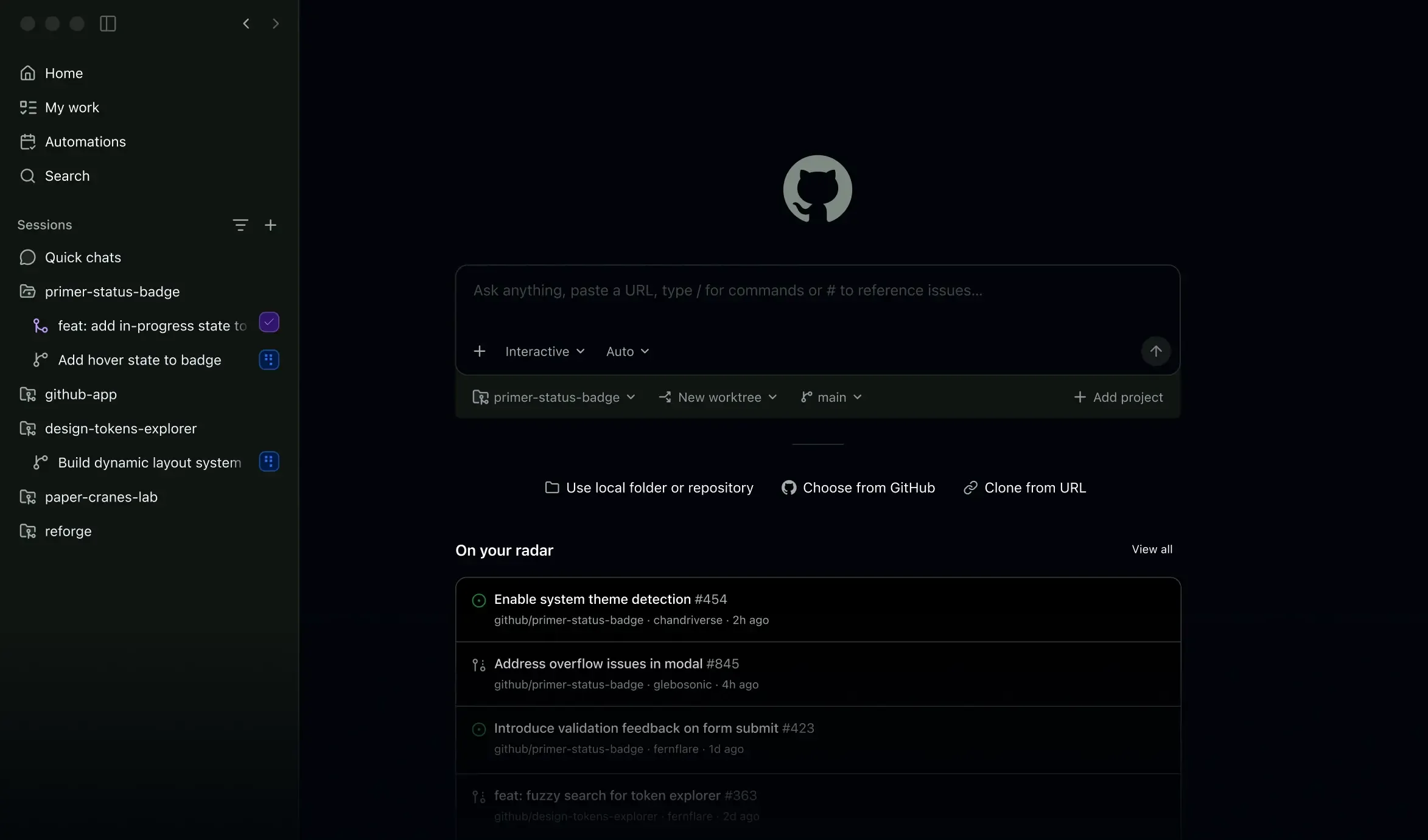
The official Copilot app image shows repositories, recent sessions, and the task prompt in one workspace.
Small playable mechanics, repository-level implementation, debugging, refactoring, tests, and code review across Web, Godot, Unity, and Unreal workflows. This assessment does not promise autonomous completion of a whole game, complete visual-editor awareness, a model-quality ranking, or a fixed success rate.
Beginner scope: A first small, reversible playable mechanic in an existing game project, not unattended completion of a large commercial game.
Agent scope: Let another application, agent or CI process delegate a bounded repository task to Copilot and retrieve text, events or code changes.
Confidence: learning Medium · Agent High
These are independent editorial judgments, not an overall score or a claim of hands-on agent integration testing.
KEY FINDINGS
Positive and negative reports converge on project instructions, clear acceptance criteria, smaller sessions, real-engine checks, diff review, and rollback. Wide tasks and missing engine context create more drift.
O19U01U03U04U05U06U07U11Current cost depends on model rates, token volume, context, cache behavior, tool loops, review effort, and Actions. User exit reports reinforce the need for budgets, but do not provide a representative consumption distribution.
O03O04O14U08U09EDITORIAL VERDICT
GitHub Copilot now deserves to be evaluated as a multi-surface coding-agent platform, not only as autocomplete. It can materially lower the path from a game idea to a first playable mechanic, including for people who cannot yet code. That does not make programming and engine knowledge irrelevant: those skills increasingly determine whether the creator can diagnose outdated APIs, protect architecture, review permissions, and maintain a larger project. The strongest workflow is a supervised loop of one small change, real-engine playtesting, diff review, and rollback. Its external-agent integration is easy because the GA SDK and programmatic CLI provide a documented send-and-retrieve loop, with ACP as an additional preview route.
BETTER FIT
POORER FIT
WORKFLOW FIT
Describe one player-visible behavior, engine version, relevant systems, constraints, and acceptance checks; ask Copilot to inspect before editing.
Review the proposed files and plan, create a Git checkpoint, and allow only the commands, paths, URLs, and network access the task needs.
Let Copilot run available compilation, tests, or diagnostics, then open the actual editor, build, device, or browser and play the changed path.
Inspect the diff, public-code references, runtime behavior, and tests. Keep a good change, request one bounded repair, or return to the checkpoint.
RECOMMENDED WORKFLOW
Start from a testable brief, then move through prototyping, assets, audio, testing, and release with an explicit handoff and human check at every step.
SHORTEST RESPONSIBLE PATH
This is a low-risk starting workflow synthesized from the evidence.
Create or open a tiny Git-managed Web, Godot, Unity, or Unreal project that already runs.
Write the engine version, relevant files, one player-visible behavior, and a short acceptance checklist.
Ask Copilot to inspect and propose a plan; reject scope growth before allowing edits.
Checkpoint the repository, grant minimal tools, apply the change, and run available builds or tests.
Play the exact path in the real game, inspect the diff and code references, then accept, repair once, or revert.
PRICING & RIGHTS
Pricing and terms last checked: Sep 10, 2026
Illustrative arithmetic for 100,000 uncached input tokens plus 10,000 output tokens, with no cache, cache-write, long-context tier, or automatic-model discount. It is not an observed Copilot session and not one accepted game feature.
O03O04O14The envelope costs $0.045 at the selected current rate. Low nominal cost does not establish equivalent capability or a playable result.
The same envelope costs $0.60. A real Agent task can invoke the model repeatedly and consume more context.
The same envelope costs $1.50. Ten theoretical envelopes do not mean ten accepted mechanics.
This is one of the few official feature-level ranges. Pull-request size, model choice, instructions, and separate Actions minutes still change total cost.
Actual accepted-feature cost = subscription allocation + extra AI Credits + Actions, builds, and other tools + human planning, review, playtesting, debugging, and rework, divided by playable changes that actually pass. Public evidence does not provide a common acceptance rate or labor denominator, so that value remains unknown.
GitHub does not claim ownership of your Input or Output under the individual Copilot terms. Output can still resemble training or public code, and you remain responsible for licenses, third-party rights, security, and suitability. Public-code references and filters help review; they are not an infringement guarantee. Individual Pro, Pro+, and Max do not include the IP indemnity offered with eligible business plans. This is not legal advice.
Set a hard additional-use budget before long Agent or review work. Personal inputs and outputs may be used for improvement or training unless the user opts out, and hosting or retention varies by model provider and feature. Remove secrets, check the selected path, and do not copy Business or Enterprise protections onto an individual plan.
PRODUCTION RISKS
Outdated APIs, package versions, scene objects, Inspector values, Blueprints, resources, and runtime state can make compiling code wrong in practice. Give version context and verify in the actual engine.
O19O20U04U05U06Wide prompts and long or asynchronous sessions can reach the wrong destination before the creator can intervene. Split tasks, define acceptance, inspect the plan, and keep rollback points.
O19U01U07U11Model, context, tokens, tool loops, review effort, cache behavior, and retries change consumption. Base plus flex is a monthly pool, not a guarantee of tasks or finished features.
O03O04O14U08U09CLI, SDK, ACP, MCP, and cloud tools can read files, run commands, reach URLs, or change repositories. Isolate work, minimize allowlists, protect secrets, and review every pull request.
O08O09O10O12O13Individual training opt-out, provider-specific retention, public-code matches, and third-party licenses require configuration and review. Enterprise exclusions or indemnity do not automatically apply.
O02O07O15O16O17O18NOT VERIFIED
RESEARCH METHOD
Research-reviewed from public evidence. We checked twenty-four official product, billing, model, interface, terms, data, and game-workflow sources, then coded fourteen principal records across GameDev.net, Reddit, Unity Discussions, GitHub Community, Hacker News, and Epic Developer Community. Reddit and Unity contribute four records each, below half of the set; positive, negative, and exit evidence are all retained. Tutorials and plugin authors establish that a path exists, not independent quality. Pre-June-2026 billing and older product experiences are separated from current facts. No star ratings, vendor promises, or isolated complaints are converted into a success rate.
Official product scope across editors, GitHub, the command line, agents, and code review.
Current individual plan prices, included capabilities, and plan-level protections. The Max FAQ conflicts with the detailed billing table on included credit value.
Authoritative current base, flex, total-credit, reset, additional-use, and metering rules used for this page.
Current per-token model rates and context tiers. Selected rates support illustrations, not model rankings.
GitHub's announcement that current plans moved to GitHub AI Credits on June 1, 2026.
Billing surfaces, budgets, Actions interaction, and account-level context.
Official limits covering incorrect, insecure, or unsuitable code and the need for human review.
Interactive and agentic terminal scope, tools, permissions, and account access.
Non-interactive prompts, silent output, tool allowlists, and scripting behavior used for the external-agent assessment.
GA SDK status, six supported languages, custom tools, MCP, hooks, authentication, BYOK, and remote sessions.
Session creation, sendAndWait, response retrieval, and managed CLI setup.
Public-preview ACP over stdio or TCP for IDE, CI, frontend, and multi-agent clients.
Asynchronous repository tasks, ephemeral Actions environment, one-repository and 59-minute boundaries.
Review workflow and official Lite and Balanced AI-credit estimates; Actions minutes are separate.
Section J covers input and output ownership, similar output, third-party rights, and individual data use. Not legal advice.
Model-provider hosting, retention, and training-use differences between individual and business customers.
Organization controls and surface-specific content-exclusion limitations.
Public-code matching, filtering, references, and user review responsibilities.
Current Unity workflow guidance on project instructions, task decomposition, and context degradation.
C++ symbol, reference, hierarchy, and call-chain context for Windows game development.
Legacy 300 and 1,500 premium-request allowances apply only to eligible existing annual subscribers and do not represent the current default.
GitHub can host partner agents such as Claude Code and Codex; this is not the reverse path of an external agent calling Copilot.
Current desktop-app availability across individual plans and operating systems.
Documentation view of current plan eligibility and feature distinctions.
An experienced creator reports major progress with Copilot while documenting questionable implementations, code-quality issues, review, and rework.
A designer and illustrator who cannot code reports sustained progress on a 2.5D narrative game, alongside repeated frustration and learning.
A Unity user describes Plan-to-Agent implementation and compilation repair; its pre-June request-cost description is historical only.
Users value repetitive completion but report ECS and UnityEngine.Random versus System.Random mistakes that can survive superficial review.
A specific outdated-API failure supports version-context risk, not a claim that current Copilot always fails this way.
A current discussion contrasts weak default Unity C# completion with better results from skills, memory, headless Unity, or MCP context.
Users report useful debugging and clear-spec implementation, while larger under-specified tasks drift and need smaller sessions.
Launch-day reports describe unexpectedly rapid credit use and explicit cancellation or migration plans; early anomalies are not treated as a typical distribution.
The same thread contains Pro+ cap frustration, exit intent, and users staying for reliable IDE integration or inline completion.
A claimed 600-hour comparison and opposing replies show strong harness-dependent disagreement; it is historical context, not a current ranking.
A user likes asynchronous work but reports wrong destinations and slow correction loops compared with local supervision.
A plugin author demonstrates project access, C++ creation, search, and compilation and reports using it with an eleven-year-old; it is ecosystem evidence, not independent reproduction.
A playable-prototype tutorial also records permissions, disconnects, and domain-reload debugging friction.
Historical reports combine strong value at $10 with slower edits and weaker completion than alternatives; not evidence for current billing or ranking.
DISCLOSURE
Independent editorial research. MakeGameWithAI has no affiliate link, sponsorship, vendor-provided account, credits, interview, or technical support for this review. Owner Review approved the multi-surface platform positioning, beginner-friendly / medium decision, easy Agent integration / high decision, current-credit framing, and rights and data boundaries on September 10, 2026, then approved publication on September 14, 2026.
This public research review will be revisited when pricing, terms, product versions, or material new evidence changes.