Structured source of truth
Keep IDs, source and target text, context, dependencies, state, history, and permissions together so a source change can make affected translations visible.
O05O13O14O15O16U03U07U08Keep changing game text, translators, and builds in one traceable localization flow.
PRODUCT OVERVIEW
Gridly is a cloud collaboration platform for structured multilingual content. Game teams organize source text, stable IDs, target languages, context, characters, limits, screenshots, status, and other metadata as records and fields, then use Views, dependencies, history, branches, automations, tasks, and APIs to control how content changes and moves.
The product is sold as three modules that can be purchased separately. CMS is the structured content source and automation layer; TMS manages translation jobs, workflow, progress, and delivery; CAT gives translators an editor with context, translation memory, search, and suggestions. A team may need one module or a combination—three price cards do not mean everyone must buy all three.
Gridly's generative features sit inside that workflow. AI-assisted translation and Pre-translation are currently documented as Beta, with translation memory and machine translation followed by QA and human review. The separately marketed Localization Agent says Launching Fall 2026, so this page does not treat it as generally released. Gridly's durable value is content coordination and delivery, not a promise that AI produces final game localization by itself.
A 14-day Team trial is publicly described for all modules, after which help material says the account becomes read-only until a plan is selected. The current public material reviewed here does not confirm whether a payment card is required. API allowance and features depend on the purchased tier and module.
Keep IDs, source and target text, context, dependencies, state, history, and permissions together so a source change can make affected translations visible.
O05O13O14O15O16U03U07U08Buy content management, translation management, translator tooling, or a combination according to the actual handoff rather than treating the full feature list as the minimum plan.
O01O03O05U07CSV and JSON routes, official Unity and Unreal packages, and REST record operations create real ways to move approved content into a game. Mapping, stable IDs, secrets, imports, and engine checks remain project work.
O13O14O15O17O18O28O29U02U05U11U12Beta tools can suggest, rewrite, pre-translate, and run rules. The final language, character voice, cultural fit, variables, and in-game layout still need qualified human review.
O07O08O11O12O21U07INTERFACE & EXAMPLES
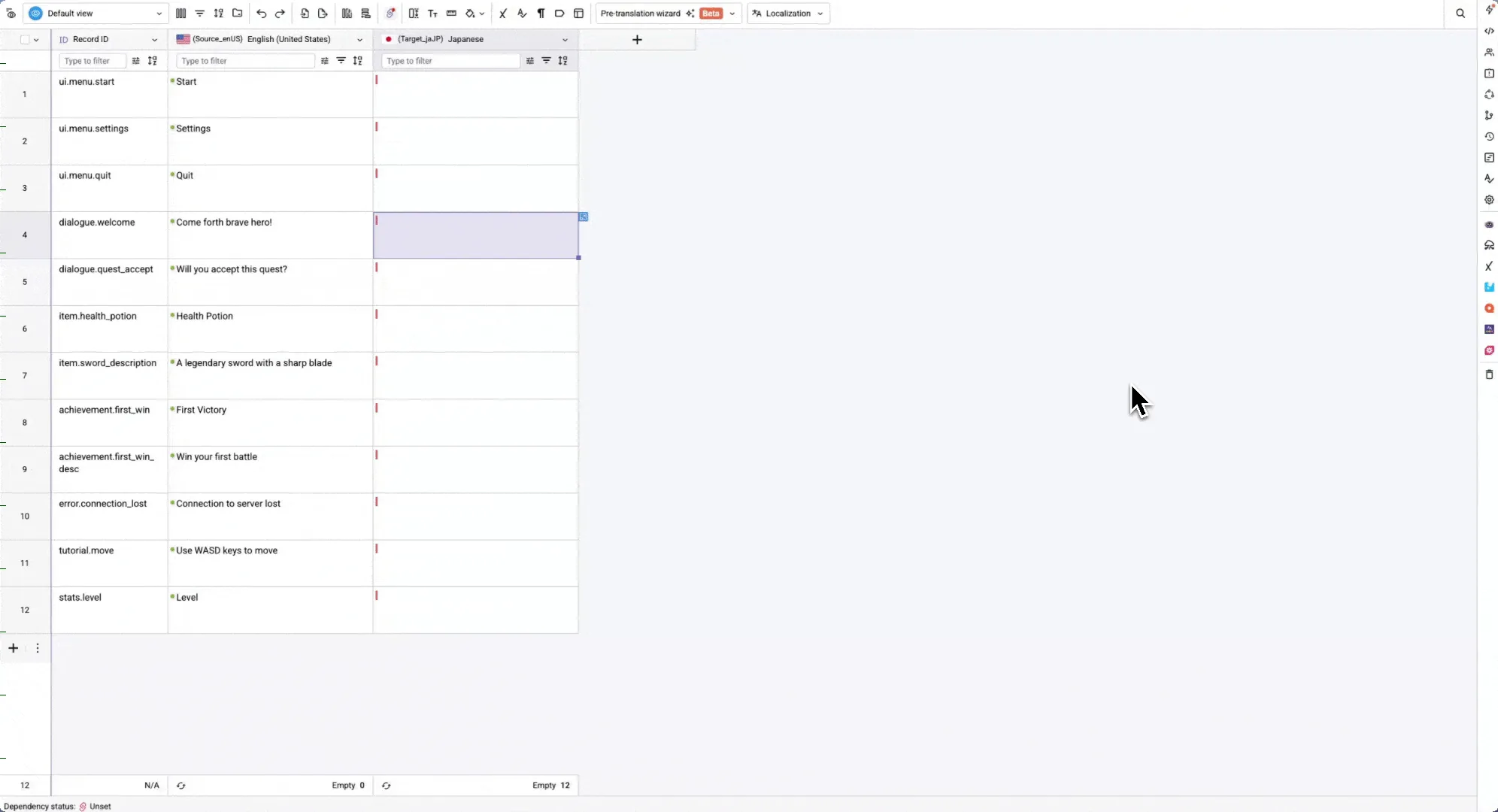
A frame from Gridly's official walkthrough shows game strings organized into records and language columns.
Continuously changing game text with multiple target languages, collaborators, translators, or repeated builds. This assessment does not promise one-click translation quality, current large-table speed, seamless engine synchronization, or cost effectiveness for a small one-off solo project.
Beginner scope: Structuring and coordinating changing game text for a small multi-language project, not guaranteeing translation quality for a complete release.
Agent scope: Let an external agent read or update scoped Gridly records as part of a localization pipeline, with human approval before production delivery.
Confidence: learning Medium · Agent Medium
These are independent editorial judgments, not an overall score or a claim of hands-on agent integration testing.
KEY FINDINGS
Across professional accounts, reviews, and official workflows, the recurring benefit is keeping context, language state, changes, people, and delivery connected—not generating isolated translation lines.
O05O13U01U02U03U04U06U07U08At €50–€140 per month before VAT for one Basic module, the platform needs enough changing content and coordination cost to offset subscription and migration work. A low-key-count selection record illustrates that threshold without proving the product is overpriced for everyone.
O01U05U10EDITORIAL VERDICT
Gridly is most useful when localization is an ongoing content operation rather than a one-time export. It can replace fragile spreadsheets and file handoffs with stable records, context, workflow, QA, and programmable delivery, but that value grows with source-text change, language count, and team handoffs. A beginner can follow the import and interface path, yet needs some localization and data basics. Its documented REST API and controlled keys make external-Agent integration relatively easy; the Agent must still respect the schema, plan limits, secrets, review states, and human language approval.
BETTER FIT
POORER FIT
WORKFLOW FIT
Define stable IDs, source language, target fields, context, variables, length limits, ownership, and review states; import a small representative file first.
Reuse approved TM and terminology, optionally create Beta pre-translations, mark machine output, and assign it to a qualified reviewer with QA rules.
Export a reviewed file or use one official plugin or REST flow, compare IDs and conflicts, then verify variables, layout, fonts, and fallbacks in the game build.
RECOMMENDED WORKFLOW
Start from a testable brief, then move through prototyping, assets, audio, testing, and release with an explicit handoff and human check at every step.
SHORTEST RESPONSIBLE PATH
This is a low-risk starting workflow synthesized from the evidence.
Choose twenty representative strings with stable IDs, variables, context, limits, and two target languages; use non-sensitive sample content.
Import them into one Grid and make three source-text changes to see whether affected translations and owners remain visible.
Run terminology and QA on deliberately planted number, variable, punctuation, and length issues; keep machine suggestions unapproved.
Export and reimport a small reviewed batch, then choose either Unity, Unreal, or REST for one controlled delivery—not all routes at once.
Check the game build, export a complete backup, revoke test keys, record the real handoff time, and only then decide which modules and seats are worth migrating.
PRICING & RIGHTS
Pricing and terms last checked: Sep 6, 2026
Public add-on rates checked September 6, 2026. Calculations are linear, before any listed free allowance, base modules, VAT, target-language multiplication, upstream API bills, translation-memory reuse, retries, or human review.
O01O02O03O04O09O10The listed rate is €19.95 per million characters. These are machine-processed characters, not approved strings.
The listed rate is €24.95 per million characters. The 10,000-character allowance is not applied because its reset interval is unclear.
The listed rate is €49 per million characters. Current BYOK documentation leaves possible upstream OpenAI billing unresolved.
Basic TMS plus one nominal million OpenAI characters. It excludes CMS/CAT, seats, human review, and any upstream API charge; it is not a recommended bundle.
Cost per accepted target string equals module and seat fees, Gridly add-ons, upstream providers, implementation, translation, review, and maintenance divided by strings that pass human review and enter the build. Public character rates do not provide that denominator.
Gridly is sold for commercial content operations, and its terms say customers retain ownership of Customer Content while granting service-related rights. The customer must have rights to uploaded source text, translations, screenshots, and other materials. AI output can be inaccurate or non-unique, and third-party provider terms may also apply.
Paid terms, renewal, cancellation, refunds, order forms, logo publicity, provider data terms, data region, and exact checkout totals need account- and contract-level review before migrating confidential production content.
PRODUCTION RISKS
CSV and JSON preserve content, but Views, dependencies, branches, tasks, comments, tickets, permissions, automations, TM, and glossary do not automatically migrate as one equivalent system.
O13O14O15O19Restrict and revoke API keys, keep them out of clients and repositories, preview imports, export backups, and separate development live-preview access from production delivery.
O16O17O18O28U11U12The older provider disclosure and newer integration-key list differ, while AI features can invoke third parties. Confirm the enabled provider, region, retention, training, deletion, and billing path for the exact action.
O09O10O20O21O22Stable schemas, roles, imports, plugins, and review rules take setup time. For little, stable text and one translator, engine-native files plus version control may remain simpler.
U02U04U05U08U10NOT VERIFIED
RESEARCH METHOD
Research-reviewed from public evidence. We coded twelve records across G2, MultiLingual, Localization Academy, Reddit, and GitHub, spanning a review platform, named professional accounts, an independent first-use walkthrough, a community selection record, and technical issues. Six G2 records are exactly half of the set and retain invitation or incentive labels. Vendor customer stories, brand logos, and alpha-pilot savings were excluded from independent evidence. The record supports a scoped workflow and integration judgment, not a quality, performance, or savings benchmark.
Current CMS, TMS, and CAT module prices, included seats, tier limits, and trial statement.
Listed machine-translation, lexiQA, CDN, and other add-on rates; the reset and dual-billing boundaries are not fully explained.
Company-level billing, advance payment, periods, and seat concepts.
VAT, trial, tier, seat, and purchasing details.
Product modules, game-localization positioning, and general workflow scope.
Current maintenance and feature timeline. Release notes do not establish stability in every account.
Cell-level translation, rewrite, shortening, variation, correction, sentiment, and custom-prompt features marked Beta.
Beta flow combining translation memory, machine translation, markings, and QA.
Current automation documentation requires the customer's own OpenAI API key and says model cost follows that account.
Third-party provider key configuration and current provider list.
Rule-based checks for omissions, numbers, punctuation, and other defects; not a guarantee of linguistic quality.
Human quality evaluation models, categories, and ticket workflow.
Localization file export, modification, preview, and reimport workflow.
JSON import and export behavior for structured content.
CSV field mapping and import behavior.
View filtering and the important distinction between hiding and deleting underlying records.
Official open-source Unity data synchronization package and setup requirements.
Current UE5.8 plugin, manual setup, language mapping, and import/export route.
Customer-content rights, subscription term, renewal, refund, liability, and customer-logo conditions. Not legal advice.
Data categories, processors, international handling, deletion, and retention context.
Inputs and outputs as Customer Data, third-party AI use, non-unique or inaccurate outputs, and user review duties.
Provider disclosure last marked September 2024; it does not fully match the newer integration-key list.
Vendor statements on certification, encryption, hosting, and backups; not an independent audit by this site.
Additional account and security documentation.
Public service-status entry. A current green state cannot prove historical or account-specific availability.
Marketing page says Launching Fall 2026 and offers early demos; it is not treated as broadly released.
Early product documentation that does not override the launch status on the product page.
Read-only and restricted key controls, regeneration, disabling, and revocation.
Official REST record operations, API-key authentication, and plan-level access boundaries.
An incentivized small-business review describes publishing game and competition content through the API, with slowdown at tens of thousands of rows.
An incentivized localization-director review values centralization and plugins while reporting Unreal mapping and import conflict friction.
A natural-review record says daily changes are visible in the game and Views help, while the interface often feels slow.
A computer-games review, updated in 2025, describes automation benefits alongside loading, group, and permission friction.
An invited small-business programmer finds direct Unreal transfer approachable but wants a free or single-seat option.
An invited localization lead describes routine import, export, versioning, and automation value alongside missing operations and separate ChatGPT cost.
A named Social Quantum localization lead describes CMS, API, MT plus human editing, and language-dependent results. One team cannot define a universal saving rate.
A three-game localization migration account values TM, glossary, roles, history, and repository connections while documenting training and process change.
An older shallow first-use walkthrough supports discoverability of basic project, language, and export paths, not current performance.
A developer with about 1,200 keys across small projects sees the subscription as expensive. They did not report hands-on Gridly use.
A historical key-in-build issue supports least-privilege and production-separation safeguards; it is not asserted against current UE5.8.
A historical generated-ID import issue makes stable IDs and previewed imports important test points, not a current universal defect.
DISCLOSURE
Independent editorial research. MakeGameWithAI has no affiliate link, sponsorship, vendor account, extended trial, free credits, or technical support for this review. Owner Review approved the research and the two scoped decisions on September 9, 2026.
This public research review will be revisited when pricing, terms, product versions, or material new evidence changes.