Build a system as a runnable diagram
Represent sources, stores, sinks, conversions, probabilities, gates, and feedback so dependencies no longer live only in prose or a spreadsheet.
O01O04Turn a game-system question into a diagram you can run before you build it.
PRODUCT OVERVIEW
Machinations is a browser-based modeling and simulation tool for game systems and economies. Ask AI Builder to draft a diagram from text, or connect sources, resource pools, drains, converters, probabilities, parameters, and feedback loops yourself. Step and Interactive Play expose how resources move; repeated Predictions and charts show distributions and extreme paths under the assumptions you entered.
AI Balancer can search parameter combinations toward one numerical target. Google Sheets supports parameter handoff, and an open-beta Unity route can connect selected model values with a project. These are tools for making rules and consequences discussable—not an automatic certificate that a game is balanced, fun, fair, or ready to ship.
Use it in a desktop browser. Community starts without a credit card but makes the account and diagrams public under CC0; private work begins with a paid account. Every simulation, formula, resource movement, and AI context can consume Events.
Represent sources, stores, sinks, conversions, probabilities, gates, and feedback so dependencies no longer live only in prose or a spreadsheet.
O01O04Use Step and Interactive Play to inspect paths, then Predict and charts to compare distributions. More playthroughs reduce sampling noise, not modeling error.
O05O06O07AI Builder lowers the blank-canvas barrier, while AI Balancer searches up to ten influencers toward one target. Humans still define the target and judge alternatives.
O01O08O09O15Sheets, CSV, and Unity paths can move selected data onward, but synchronization scope, ownership, and validation must be planned explicitly.
O10O11O12O13O14INTERFACE & EXAMPLES
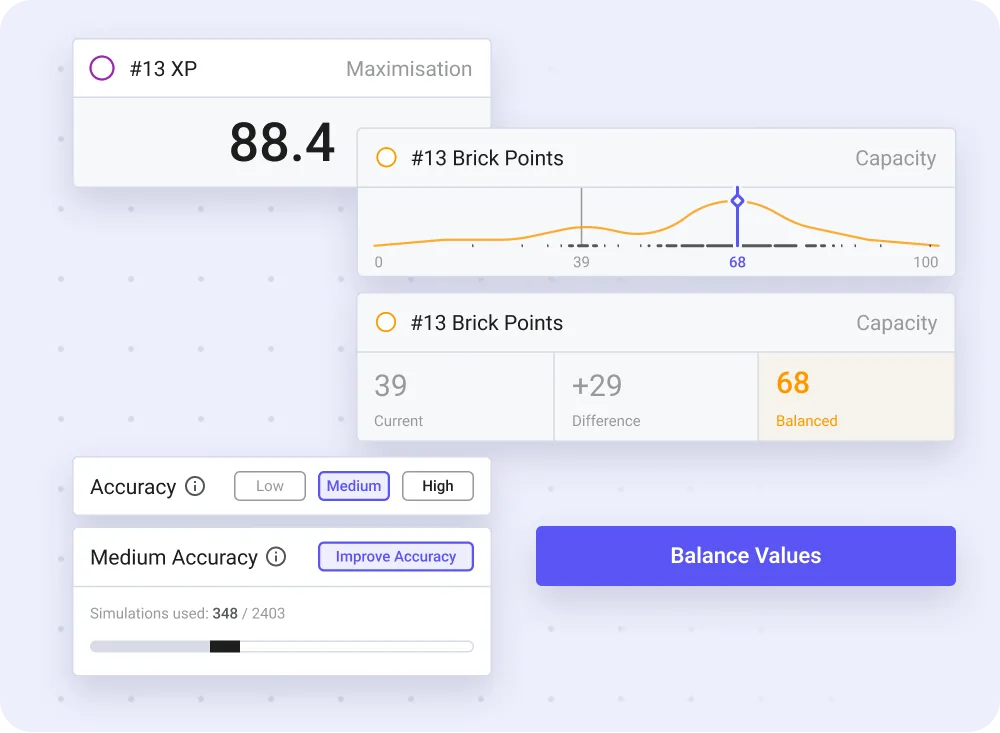
Machinations' official Balancer illustration combines a target metric, value distribution, and balancing controls.
This page evaluates whether Machinations is worth trying for one bounded game-system question. It does not measure simulation correctness, current AI quality, typical Event usage, Unity performance, player prediction accuracy, or business outcomes.
Beginner scope: Build and interpret a small resource loop or economy model.
Agent scope: A design-to-simulation workflow; the confirmed interface covers data interaction with existing diagrams.
Confidence: learning Medium · Agent Medium
These are independent editorial judgments, not an overall score or a claim of hands-on agent integration testing.
KEY FINDINGS
Across a small-game review, a Defold example, an economy analysis, an academic project, and a management-game report, users repeatedly found value in turning loops and dependencies into something runnable. The benefit was often discovering tradeoffs and better questions—not receiving a final prediction.
U01U03U05U06U08Text-to-diagram and visual nodes lower the starting barrier. Independent reports still surface a learning curve around nodes, values, formulas, abstraction, and deciding what a Step means. AI can draft structure; it cannot decide which rules faithfully represent the game.
O01O04U01U03U04A very small team may get the same answer from Lua, a spreadsheet, or a rules engine. A commissioned project also found integration unjustified while mechanics were still moving. Scope the first model around one decision whose implementation or reversal would be expensive.
U04U07U08Monte Carlo playthroughs reduce random sampling noise inside the model. They cannot repair missing behaviors, incorrect parameters, or a false assumption about players. Important conclusions still need a hand check, prototype, playtest, or real data.
O06O07U05U08The documented Balancer searches up to ten influencer values around one target. That can narrow parameter candidates, but the target, constraints, simulation horizon, and comparison criteria are human choices. Current independent evidence is too thin to claim a reliable complex-game success rate.
O08O09U03Sheets and Unity create handoff routes, but current Unity coverage is Open Beta and real-time sync is limited. Parameters, formulas, experiments, and analytics can drift between the diagram and implementation unless ownership and validation are explicit.
O10O11O12O13O14U07U09EDITORIAL VERDICT
Machinations is worth a small, low-risk trial when a game has interdependent resources, random rewards, progression curves, production chains, or feedback loops that would be expensive to implement incorrectly. A non-programmer can begin with text and visual nodes, but trustworthy work still requires clear rules, Step definitions, probabilities, and independent validation. Start with one costly question—not a second representation of the entire game.
BETTER FIT
POORER FIT
WORKFLOW FIT
Model one resource loop, progression curve, drop system, or production chain and compare a few explicit scenarios before paying the engineering cost.
Use the diagram to explain surprising behavior and select parameters worth trying, then implement them in a playable build.
Move selected values through Sheets, CSV, or the conditional Unity path when the maintenance benefit is clear.
RECOMMENDED WORKFLOW
Start from a testable brief, then move through prototyping, assets, audio, testing, and release with an explicit handoff and human check at every step.
SHORTEST RESPONSIBLE PATH
This is a low-risk starting workflow synthesized from the evidence.
Write one decision question, such as whether difficulty spikes within 50 levels, and define exactly what one Step represents.
Use synthetic, non-confidential values to build the smallest loop in Community. Do not upload an unreleased economy, client material, or a core secret design.
Run step by step until every resource movement and trigger behaves as intended; only then run a small Prediction and inspect unusual paths.
Repeat the same task once, read its Event tracker, and use that measured E to calculate Starter or Pro capacity. Do not borrow another diagram's Event count.
Sanity-check one result with a spreadsheet, hand calculation, or small script, then validate the important conclusion in a playable prototype or real data.
Pay for privacy or expand the model only when repeat simulation or collaboration clearly outweighs subscription and maintenance cost; retain parameter and result backups.
PRICING & RIGHTS
Pricing and terms last checked: Sep 1, 2026
Monthly nominal allocation assumes the whole included quota is used: Starter $20 ÷ 200,000 = $0.10 per 1,000 Events; Pro $200 ÷ 4,000,000 = $0.05 per 1,000 Events. Actual payment is still $20 or $200 even if you run once, and unused quota raises the effective unit cost.
O02O03At full use, 1,000 included Events carry a $0.10 nominal allocation. This is an allocation inside a subscription, not a pay-per-run checkout.
200,000 ÷ 10,000 fits 20 theoretical runs, and $20 × 10,000 ÷ 200,000 allocates $1 to each. It does not say a run answers the question or that 10,000 is typical.
4,000,000 ÷ 10,000 fits 400 theoretical runs, and the monthly allocation is $0.50 each. The real subscription threshold is still $200 per month.
A high-use task can consume Starter quickly. Four runs are not four complete economies, and the scenario is illustrative rather than measured product usage.
Community, Starter, and Pro display $0.00020, $0.00016, and $0.00010 per Event before applicable volume and tier discounts. Checkout totals and tax were not tested.
Use total subscription and top-up spend plus modeling, debugging, maintenance, and validation time, divided by conclusions later accepted and confirmed in a prototype or real data. No acceptance rate makes that denominator available today.
The 1,000, 10,000, and 50,000 Event scenarios are sensitivity arithmetic—not typical diagram sizes, measured bills, or promises of a useful answer. Failed-request charging and automatic Event refunds were not established. Measure your own repeatable task before choosing a plan.
Paid-account content is private by default and user content remains owned by the user under the service license. Community accounts and diagrams are public, and their content is automatically dedicated under CC0; later privatizing or deleting it does not revoke rights already received by people who accessed it. Terms section 4 limits Community to personal, nonprofit, or academic use, while section 7 also names professionals below $100,000 in revenue or funding. Because that eligibility conflicts internally, use allowed_with_conditions: confirm the applicable contract for commercial work and use a paid private account for confidential designs. This is not legal advice.
Subscriptions renew automatically, monthly quota does not roll over, and the service is not a backup. Current privacy text predates the AI-first entry point and does not clearly identify AI model providers, training use, a dedicated retention period, or an opt-out. Use synthetic non-confidential data for a free trial, keep your own copies, and verify checkout and account-specific terms before paying.
PRODUCTION RISKS
A free diagram is not merely visible—it is dedicated for broad reuse under CC0. Do not place an unreleased economy, customer data, or a proprietary core loop there. Moving private later cannot recover rights already granted.
O16Simulation output inherits the model's structure, Step meaning, parameters, and player assumptions. Use independent checks and treat unusual certainty as a reason to inspect the model rather than trust it more.
O05O06O07U05U08When rules change, the diagram, spreadsheet, engine values, tests, and analytics can drift. Unity is still Open Beta and sync covers selected structures. Assign ownership and define which representation wins.
O10O11O12O13O14U07U09AI Builder can read prompts, diagrams, uploaded files, and simulation data, while the published privacy policy predates this workflow and the subprocessor list does not name an AI provider. Get current contractual answers before sensitive use.
O03O16O17NOT VERIFIED
RESEARCH METHOD
Research-reviewed from public evidence. We checked 18 official sources and coded 9 independent records across 8 effective platforms and 6 source environments: review platforms, an engine community, professional analysis, academic projects, a broad design community, and a competitor analysis. Fourteen platforms or site groups were searched. Defold contributes 2 of 9 records (22.2%); Reddit contributes 1 of 9 (11.1%). Invited or incentivized review, vendor support, historical pricing, anonymous identity, and competitor bias are disclosed and down-weighted. Conflicting reports about value, complexity, precision, project stage, and model drift are retained. Confidence is medium for bounded workflow fit and low for current AI quality, Event distribution, Unity production behavior, and accepted-conclusion cost.
Current text-to-playable-diagram entry point and product positioning. Efficiency and accuracy claims are not treated as measured outcomes.
Community, Starter, and Pro prices, monthly Event quotas, top-up rates, visibility, performance, and current annual amounts.
What creates Events, AI Builder metering, top-ups, shared-diagram charging, and quota expiry. Its 17% annual-discount wording conflicts with current prices.
Browser-based visual modeling, simulations, charts, AI, Sheets, and CSV capabilities. Vendor outcome claims are excluded.
Step, Interactive Play, and Predict behavior. A Step is defined by the model author and is not automatically a real-world time unit.
Repeated random sampling reduces sampling noise but cannot repair incorrect structure, parameters, or player assumptions.
Mean, median, range, PNG, and plan-dependent CSV outputs. Charts describe the model, not observed player behavior.
AI Balancer searches up to ten influencer values toward one selected numerical target; that target is not a definition of fun or fairness.
Candidate parameters and averages depend on the target, steps, and simulation count; alternatives still need human comparison and validation.
Documented import and export route. Changes need another import or save, so the sheet and diagram do not remain synchronized automatically.
Current ready-made plugin coverage is Unity Open Beta; Unreal remains on the roadmap. A roadmap is not a delivery date.
Unity Open Beta setup and ScriptableObject handoff. This review did not install or benchmark the integration.
Current sync scope includes Pools and Resource Connections; it does not make every node, formula, or runtime state production game logic.
Official example repository showing one integration route. Its README labels some formula handling very early and it is not independent production evidence.
Tracks the August 2025 Events transition and 2026 AI Builder, Agents, Dashboard, and AI changes used to date older reports.
Paid and Community content rights, account eligibility, renewal, cancellation, backup, and privacy text. Community eligibility clauses conflict internally.
Lists hosting, support, analytics, payment, and email providers. It does not identify the AI model provider or settle AI training and retention questions.
Useful conservative limits and support context, but several agent, prediction, and SSO entries lag the current product and changelog.
A verified small-game developer reports checking RNG and gameplay loops before prototyping, while still needing code or logic understanding for nodes and values. The review was invited and incentivized.
A creative director liked the tool but said the then-current 100-component limit blocked studio adoption. The August 2025 Events model removed that specific limit, so this is historical change evidence.
A first-time user turned a 50-level puzzle difficulty and churn question into a diagram and result, finding the workflow more suitable than Excel for that example. No later accuracy validation was provided.
Another developer argues that this class of tool can be excessive for very small teams when a simple Lua simulation or rules engine already answers the question. This is a fit counterpoint, not a product failure.
A multi-diagram economy analysis changes demand, pack, and sell assumptions while explicitly warning against over-reading simplified models. The author received free access and vendor technical help.
An undergraduate project reports that decomposing a mobile-game economy improved the workflow, exposed tradeoffs, and prompted mechanic changes. It remains one author's project report.
A commissioned mobile-card-game project found formal integration unjustified while mechanics were changing and resources were limited, relying mainly on playtests, diaries, and analytics.
An anonymous designer says Machinations helped think through customer flow, scaling, and formulas, but was not precise enough to serve as the sole final-optimization method.
A competitor article credits Machinations for systems thinking while criticizing duplicate wiring and drift between diagrams, implementation, A/B tests, and analytics. Its commercial bias sharply limits weight.
DISCLOSURE
Owner Review passed on September 1, 2026, accepting this bounded public-evidence review. MakeGameWithAI has no affiliate link, sponsorship, vendor-provided account, free credits, interview, or technical support for this work, and did not run Machinations. The Naavik author received free access and vendor help; the G2 review was invited and incentivized; Leap sells a competing product. Those relationships are disclosed and limit their evidentiary weight.
This public research review will be revisited when pricing, terms, product versions, or material new evidence changes.