Structured game strings
Manage keys, unlimited languages, context, screenshots, character limits, translation history, branches and more than fifty file formats instead of passing loose text between spreadsheets.
O01O03Continuous game-localization infrastructure for strings, language assets, QA, delivery and external agents.
PRODUCT OVERVIEW
Phrase is a localization platform, not one translation model. For a game team, Phrase Strings is the source-content layer: it stores keys, locales, translations, metadata, screenshots, character limits, branches and history, while translation memory, term bases, jobs, suppliers and QA coordinate the language work around them.
Its AI direction is to place Next GenMT and an AI Translation Agent inside those language assets and controls. That can make drafts more consistent and traceable than sending isolated lines to a general chatbot, but current public evidence does not show that Phrase wins every language pair, narrative voice or game genre.
The useful production loop is source game text to Phrase, contextual translation and review, then controlled delivery back through files, CLI, REST or the official Unity integration. Fonts, variables, plural rules, layout, character voice and cultural fit still need native review and in-game LQA.
Use Phrase Strings in the browser, synchronize a repository with the CLI or REST clients, install the official package beside Unity Localization, and connect supported AI clients through the hosted Remote MCP. A Phrase account, suitable paid plan, project configuration and role permission are required for the relevant route.
Manage keys, unlimited languages, context, screenshots, character limits, translation history, branches and more than fifty file formats instead of passing loose text between spreadsheets.
O01O03Reuse translation memory and terminology, apply AI or professional translation, run documented QA checks, assign review and keep machine output separate from approved release language.
O01O13O14Use files, phrase push/pull, REST clients or the official Unity Localization plugin to synchronize reviewed content with a codebase and String Table Collections.
O05O07O10O11O22Connect a supported MCP client to the hosted EU or US endpoint, or build bounded tools with REST, CLI and six official SDK families. Existing Phrase roles and selected consent scopes still govern access.
O08O09O11O12O22INTERFACE & EXAMPLES
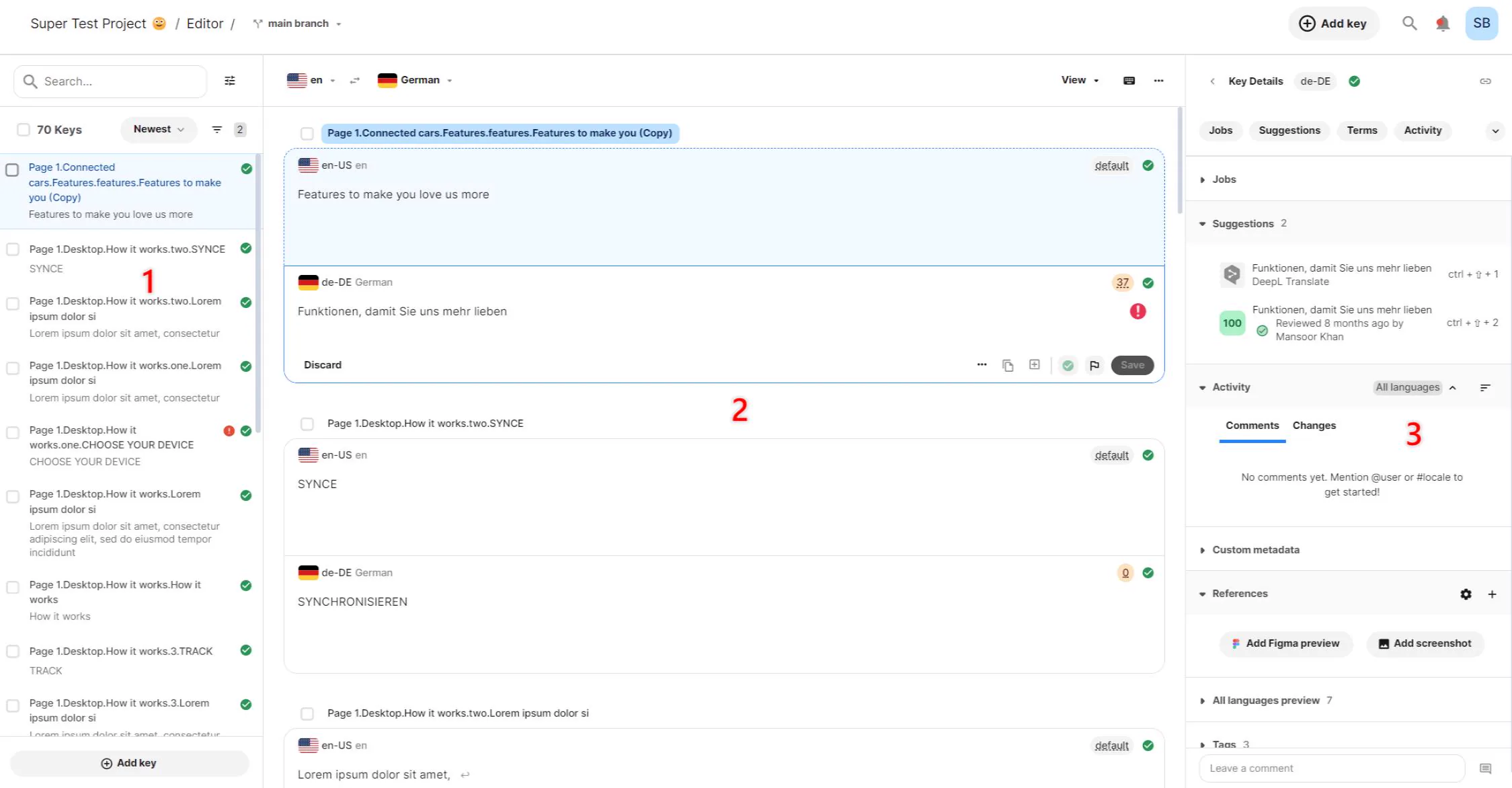
The Phrase Strings editor separates string keys, source and target text, and contextual information into three areas.
This page evaluates Phrase as continuous-localization infrastructure for game UI, system text, dialogue and live updates from current public evidence. It does not claim hands-on product testing, translation accuracy for a particular language pair, current Unity round-trip reliability, Remote MCP success rates or a measured return on investment.
Beginner scope: A solo developer or small team structures a representative set of game UI, system and dialogue strings for two target languages and completes one reviewed round trip; not autonomous localization of a full release.
Agent scope: Let Codex, Claude Code, ChatGPT, CI or another external orchestrator inspect a Phrase project, audit terminology or placeholders, create bounded work and propose controlled string changes before human language and build approval.
Confidence: learning Medium · Agent High
These are independent editorial judgments, not an overall score or a claim of hands-on agent integration testing.
KEY FINDINGS
The consistent product value is keeping changing source text, language state, context, terminology, people, review and delivery connected. That matters most after spreadsheets and direct translation calls begin creating version and ownership mistakes.
O01O18O19O20U01U03U04Next GenMT and AI Translation Agent are designed to use translation memory, terminology, style and context inside the same workflow. Official descriptions support that direction, but not a universal quality advantage over general-purpose models.
O13O14O15The official package synchronizes Phrase Strings with Unity Localization String Tables, but missing target locales can let a push create work without propagating downstream or showing an obvious error. The Asset Store has too few ratings for a current reliability judgment.
O05O06O07Hosted regional MCP endpoints, consent scopes, REST, CLI and six official SDKs provide several supported ways for an external agent to inspect or change bounded localization data. This supports an easy integration grade, not hands-free language approval.
O08O09O10O11O12O22Software UI/UX lists at $525 per month billed annually and includes Phrase Strings capacity. The $27 Freelancer row has no Strings seat, so presenting it as a game-localization starting price would be misleading.
O02Phrase-published cases establish use by game companies, while eight independent records expose learning, interface, price and automation risks. They do not establish current Unity reliability, AI dialogue quality, first-pass acceptance or solo-project ROI.
O18O19O20U01U02U03U04U05U06U07U08EDITORIAL VERDICT
Phrase is a credible shortlist option when a game has changing text, several target languages, multiple contributors and a real need to connect source control, language assets, review and release. Its strongest value is coordination and governance, not one-click AI translation. The $6,300 annual cash entry for the representative game plan, configuration work and human QA make it a poor default for a small one-off prototype. We list it without an Editorial Recommendation until current game-team evidence, Unity experience and accepted-release economics are stronger.
BETTER FIT
POORER FIT
WORKFLOW FIT
Define stable keys, source and target locales, variables, plural rules, screenshots, character limits, owners and review states before importing a representative slice.
Reuse approved translation memory and terms, apply Next GenMT, AI Translation Agent or a selected supplier where justified, then route every target language to a qualified reviewer.
Choose files plus CLI, REST, or the Unity plugin for the first round trip. Compare stable IDs, locales, variables and statuses before merging the returned content.
Start MCP or API automation with View access, list intended changes, add Create for one project, and require a diff or preview before any bulk modification.
RECOMMENDED WORKFLOW
Start from a testable brief, then move through prototyping, assets, audio, testing, and release with an explicit handoff and human check at every step.
SHORTEST RESPONSIBLE PATH
This is a low-risk starting workflow synthesized from the evidence.
Choose 100–200 non-sensitive UI, system and dialogue strings with variables, length limits and two target languages.
Define stable keys, locales, screenshots or context, terminology, owners and approval states before import.
Use the fourteen-day trial to import the slice and calculate managed-word use; do not infer the $27 Freelancer plan includes Strings.
Run one round trip through either CLI or the Unity plugin, deliberately change source text and verify IDs, target locales, variables and status propagation.
Connect the hosted MCP with View scope, ask it to audit projects, terminology and placeholders, then preview a bounded Create or update task.
Require native review and in-game LQA, record setup, correction and coordination time, and compare total annual cost with accepted language releases before buying or migrating more content.
PRICING & RIGHTS
Pricing and terms last checked: Sep 15, 2026
The platform component uses the public Software UI/UX annual price and capacity. The three translation scenarios assume five target languages, target words equal source words in each language, and the published $0.06 starting rate. Machine translation and professional translation are not both required.
O02O03O04This buys a year of platform access and listed capacity. It does not buy a translated game or guarantee that a small project will use the capacity efficiently.
60,000 managed words, or 6% of the plan, plus a $3,000 professional-translation minimum under the stated assumptions.
300,000 managed words, or 30% of the plan, plus a $15,000 professional-translation minimum under the stated assumptions.
600,000 managed words, or 60% of the plan, plus a $30,000 professional-translation minimum under the stated assumptions.
Public evidence does not supply language mix, translation-memory reuse, supplier quotes, correction time, acceptance rates or in-game LQA needed to calculate this cost.
Actual cost per accepted language release = platform, capacity top-ups, translation or MT, engineering, migration, project management, native editing, rework, layout and in-game LQA divided by language builds that pass the project's release bar. Tax, quarterly terms and top-up prices are also unknown.
Commercial use is allowed with conditions. Version 4.2 says customers retain Customer Content ownership and must hold the rights needed for submitted text, screenshots, translation memories and other assets. Machine and supplier output is not warranted accurate, complete or fit for purpose. Review the order form, DPA, providers and the Terms effective for the account; this page is not legal advice.
Version 4.2 permits some non-text model training and internal research use of Customer Content, while text-generative model training needs prior approval. Phrase's specific Next GenMT and AI Translation Agent statement says those features and their LLM providers do not train on or retain Customer Content. Treat both layers as material, prohibit special-category or sensitive personal information, confirm region, subprocessors, retention and deletion, and recheck Version 4.4 after October 4, 2026. Ordinary subscription cancellation requires at least thirty days' notice under Version 4.2.
PRODUCTION RISKS
A 10,000-source-word game with five targets uses only 60,000 of one million managed words. Measure recurring coordination and version-error savings before committing $6,300 annually.
O02O03Missing target locales can allow a push or job to occur without downstream integration propagation or a visible error. Add explicit locale and build checks around every synchronization.
O05O06MCP offers Modify/Delete, the CLI can push and clean up, and a historical multi-source issue deleted needed keys. Begin read-only, preview bulk work, use backups and branches, and keep a human approval gate.
O08O10O21U07The research-date Terms and the product-specific AI statement use different levels of scope, and Version 4.4 takes effect soon. Do not migrate unreleased scripts or player-related data on a summary alone.
O15O16O17Phrase can organize context, terminology, QA and review, but it cannot establish character voice, cultural fit, variable safety, fonts, layout and gameplay meaning without qualified language and game-build checks.
O01O13O14O16O18U01U02NOT VERIFIED
RESEARCH METHOD
Research-reviewed from public evidence. We checked twenty-two official product, pricing, capacity, Unity, developer, AI, legal, changelog and game-case sources, then coded eight principal external records across G2, Capterra, Trustpilot, GitHub Issues and Stack Overflow. No platform contributes more than two of eight. Vendor game cases establish workflow adoption only and are not counted as independent satisfaction evidence. We also searched Unity Discussions, the Unity Asset Store, Reddit game communities and GameDev.net without padding the sample with generic localization comments. No registration, subscription, string upload, Unity installation, MCP connection or API call was made or required.
Official game workflow across Phrase Strings, context, translation memory, terminology, QA, suppliers and continuous delivery. Customer examples and outcome claims remain vendor evidence.
Current annual-billing prices, seats, projects, managed words, TMS words, MTUs, AIUs, trial and professional-translation starting rate.
Defines managed words as stored source words multiplied by all configured languages, including the source language; this is capacity, not annual translation output.
Defines MTU input-code-unit billing, native versus ecosystem engine rates and repeated workflow consumption. MTUs are separate from managed-word capacity.
Official bidirectional workflow for Unity Localization String Table Collections. It also documents a target-locale configuration that can stop downstream propagation without a visible error.
Unity lists the package as a Verified Solution, but the listing did not have enough ratings to support a current user-experience judgment.
Official source repository for the Unity integration. Repository existence does not establish round-trip reliability in a particular project.
Documents EU and US Remote MCP endpoints, account sign-in, consent scopes and supported clients including Claude Code and ChatGPT.
Vendor examples for project inspection, terminology, placeholders, jobs, notifications and bulk updates. They are workflow ideas, not independent success evidence.
Official phrase init, push, pull and API-endpoint CLI route for repositories and CI.
Official token and JWT authentication for the Strings API. Credentials and least-privilege access remain caller responsibilities.
Documents pagination, concurrency and request-rate boundaries that an automation wrapper must handle.
Describes agentic translation using Phrase language assets and quality controls. Product claims do not prove quality for every language pair or game-writing style.
Current Phrase machine-translation direction using context and language assets. It is not an independent comparison with general-purpose LLMs.
Says Next GenMT and AI Translation Agent do not train or fine-tune on Customer Content and that LLM-provider agreements prohibit retention and training; broader Terms still need to be read alongside it.
Terms current on September 15, 2026: Customer Content ownership and input duties, some ML and internal-research rights, accuracy disclaimers, sensitive-data restrictions and thirty-day cancellation notice. Not legal advice.
Upcoming Terms published before review and scheduled to take effect October 4, 2026. They trigger a short-term recheck rather than replacing Version 4.2 early.
Vendor case showing a game company managing nearly twenty languages while retaining human translators. It establishes a possible workflow, not general savings or satisfaction.
Vendor case covering four-language game UI, system and marketing content. Selection bias prevents treating it as independent quality evidence.
Vendor case for a large game-localization pipeline. Its scale and reported outcomes cannot be projected onto a solo project.
Official history showing later multi-source cleanup support after a destructive historical edge case. Version-lock and preview write operations.
Official Ruby, Python, PHP, TypeScript, Java and Go clients for the Strings API.
A 2023 small-business Product Owner reports useful translator invitations, glossary management and correct-format downloads, alongside beginner complexity and room for better screenshot context. Seller-invited and incentivized.
A 2025 user reports an adaptable but complex interface, renewal, quota and workflow friction. The record predates some 2026 AI and MCP changes and is incentivized.
A 2020 product-marketing account values cross-department work, history and screenshots while noting weak immediate visibility for duplicate-string recency. Historical and non-game evidence.
A 2020 engineering account reports integration across website, email and application content, with some language navigation friction. It supports long-term integration feasibility, not current game quality.
A 2025 user says pop-ups and notifications interrupted a previously preferred CAT workflow. A single unverified report and not a game benchmark.
A 2025 user reports pricing, quota, support, account-lock and credit-calculation friction. Trustpilot warns that its small Phrase set may not be representative.
A 2024 issue reports phrase push --wait --cleanup deleting keys needed by another source in a multi-source project. Later changelog support means this is a historical safety lesson, not a claim that current versions remain broken.
A 2024 iOS developer sought a conversion and upload path because Phrase did not then support Xcode String Catalogs. Historical format-gap evidence, not a current Unity result.
DISCLOSURE
Independent editorial research. MakeGameWithAI has no affiliate link, sponsorship, vendor-provided account, trial extension, credits, translation order, interview or technical support for this review. Owner Review approved the continuous-localization positioning, some_basics / medium beginner decision, easy / high external-Agent decision, representative-plan and managed-word framing, commercial and data boundaries, and no Editorial Recommendation on September 15, 2026.
This public research review will be revisited when pricing, terms, product versions, or material new evidence changes.