Read one public Steam page
Pull public art, copy, media counts, tags, price, platforms, and review facts from a name, App ID, or URL. No Steam password is required.
O01O04Turn a vague Steam-page concern into a checklist you can verify.
PRODUCT OVERVIEW
Steam Page Analyzer is a browser-based audit for public Steam store pages. Enter a game name, App ID, or store URL and it reads the public capsule, short and long descriptions, screenshots, videos, community tags, price, platforms, and review counts. It then divides the page into four scored areas: capsule, description, screenshots, and tags.
The no-account free result includes an overall score, four category scores, issue severity, and one complete issue with evidence and a proposed fix. Full Report unlocks all issues, prioritized recommendations, PDF delivery, and re-analysis; higher one-time offers add competitor comparison, buyer-journey analysis, history, multi-game allowances, and support. The site also exposes public benchmarks, a REST API, an MCP server, and several Steam calculators.
This is a fast second opinion, not a Steamworks dashboard or sales predictor. The useful unit is a specific claim you can check against the page, Valve's rules, target-player feedback, and your private traffic data—not the headline score by itself.
Open the site in a browser and enter a public game name, App ID, or store URL. The free path needs no account or payment and currently allows two analyses per day. A generated guest report may remain accessible through a public link and can appear on the leaderboard.
Pull public art, copy, media counts, tags, price, platforms, and review facts from a name, App ID, or URL. No Steam password is required.
O01O04Score capsule, description, screenshots, and tags, then attach severity, evidence, impact points, and a proposed fix. The score is the vendor's rubric, not a Valve metric.
O01O02O03Paid offers add every issue, prioritization, PDF, re-analysis, competitors, history, and multi-game capacity. They do not guarantee CTR, wishlists, sales, or an accepted creative change.
O01O02O06Free no-key REST endpoints and a read-only MCP route can feed public Steam facts and analysis into scripts or agents. They do not edit Steamworks or expose private project metrics.
O04O11O16INTERFACE & EXAMPLES
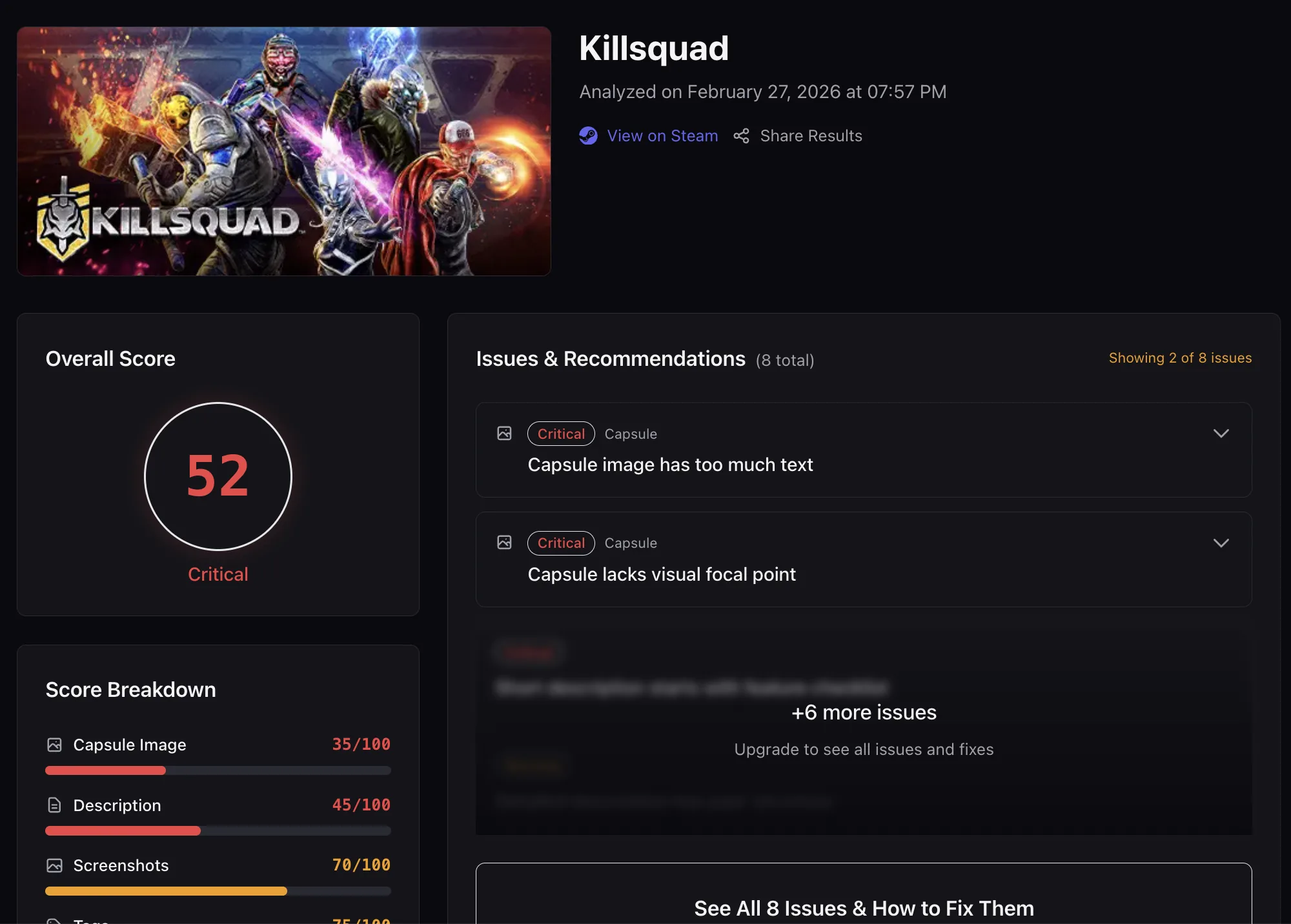
The vendor's Killsquad report example combines page scores with issues and recommendations; these scores assess the store page, not the game.
We verified one public game's free API and browser path, checked the main imported facts, and reviewed one revealed issue. We did not buy a report, edit a Steam page, measure Steamworks outcomes, test score distribution across games, or establish paid-report quality.
Beginner scope: Inspect an existing public Steam store page.
Agent scope: Retrieve store-page analysis, stored scores and reference data.
Confidence: learning Medium · Agent Medium
These are independent editorial judgments, not an overall score or a claim of hands-on agent integration testing.
KEY FINDINGS
On September 1, 2026, we analyzed A Short Hike through both the public API and browser without an account or payment. Name, price, screenshot and trailer counts, description lengths, platforms, and genres matched Steam's public data. The revealed issue correctly caught that the About section opened by repeating the short description.
U01O17The same App ID scored 78 through the API and 76 in the browser about four minutes later. Description moved from 72 to 68 and tags from 85 to 78 while the recorded public facts and eight-issue total stayed the same. Use scores as directional prompts, not a precise before-and-after instrument.
U01The repeated-copy diagnosis was concrete and checkable. Its proposed rewrite also introduced uncited playtime and acclaim language, showing why suggestions must be fact-checked and rewritten in the game's own voice before publication.
U01O02The vendor describes low CTR as throttling and higher CTR as an algorithm boost. Valve currently says store-page traffic and conversion rate do not affect visibility. Better assets can still improve the efficiency of impressions you receive, but the analyzer cannot promise extra algorithmic distribution.
O01O10O12The vendor publicly documented three rubric bugs and the ten-screenshot vision limit. It also says pre-fix scores were not recomputed, so older leaderboard entries and current reports can reflect different regimes. The transparency is useful; it does not make historical scores comparable.
O03O09Targeted searches across developer communities, review platforms, video, product directories, repositories, and social networks produced no usable independent hands-on record. G2 showed zero reviews, and promotional mentions were excluded. The supported recommendation therefore comes from one bounded first-party check, not user consensus or proven business lift.
U01EDITORIAL VERDICT
Use the free scan once when you already have a public Steam page and want a fast checklist before a festival, launch, sale, or update. In our bounded check it read the main facts correctly and found a real repeated-copy problem. Judge the cited evidence and proposed fix, not whether the score rose. Consider the $29 report only when the free issue is accurate for your game and a structured audit would save review time; there is not enough evidence to recommend the $97 or $499 offers generally.
BETTER FIT
POORER FIT
WORKFLOW FIT
Run the public page before a festival, launch, sale, or major update. Save the date, report URL, page version, scores, and issue text.
Check the cited sentence, image, order, or tag against the live page, then compare the suggestion with Valve rules and the game's actual promise.
Use target-player review for capsule comprehension and copy tone, then make one documented change so later traffic is interpretable.
Observe enough impressions and visits, record festivals, discounts, updates, and outside traffic, then keep or reverse the change based on project data.
RECOMMENDED WORKFLOW
Start from a testable brief, then move through prototyping, assets, audio, testing, and release with an explicit handoff and human check at every step.
SHORTEST RESPONSIBLE PATH
This is a low-risk starting workflow synthesized from the evidence.
Use a public App ID and save the live page plus the generated report before changing anything.
Ignore the overall score at first; open the one free issue and verify its quoted evidence on the Steam page.
Reject any claim, tag, visual direction, or marketing phrase that is inaccurate for the game or conflicts with Valve guidance.
Ask three to five target-genre players what the capsule, first screenshots, and opening copy communicate within a few seconds.
Change one important element, record the date and concurrent campaign activity, and rerun only as a secondary checklist.
Use Steamworks impressions, visits, wishlists, purchases, and source context to decide whether the change remains.
PRICING & RIGHTS
Pricing and terms last checked: Sep 1, 2026
Published prices define access units, not successful outcomes. Studio's full nominal allocation is $499 ÷ 40 = $12.475 per analysis and $499 ÷ 10 = $49.90 per tracked game. Real cost must add art, copy, research, observation, and rework, then divide by changes the team accepts and later keeps.
O01O02O06Enough to test whether one revealed issue understands the page before paying. Public-link and retention conditions still apply.
Unlocks the complete issue set and advertised re-analysis, not a guaranteed accepted rewrite or asset.
Adds competitors, buyer journey, and history; competitor selection quality and business lift remain unverified.
Fully used nominally means $12.475 per analysis and $49.90 per tracked game, averaging four analyses per game.
No acceptance rate or Steamworks outcome data reveals how many suggestions survive fact-checking, production, observation, and review.
Nominal unit prices assume every Studio allowance is useful and fully consumed. They exclude tax, currency conversion, unused capacity, art and copy production, target-player research, waiting for sufficient impressions, and rework. Confirm re-analysis limits, entitlement duration, privacy, and current checkout language before purchase.
The service is positioned for developers and studios auditing their public Steam pages. That does not transfer rights in Steam assets, certify generated copy, or make a recommendation compliant with Valve rules. Free and guest reports may be public; confirm the applicable purchase, privacy, report-sharing, and refund terms for commercial work. This is not legal advice.
Public Steam descriptions, screenshot metadata, tags, and reviews can be sent to Anthropic and stored in Supabase. Guest reports can remain public by direct link or leaderboard. Do not treat the free route as confidential, and save the checkout and refund wording because the homepage and Terms currently conflict.
PRODUCTION RISKS
Our unchanged input moved two overall points and seven tag points within minutes. The vendor also changed its rubric and left older leaderboard entries unrecomputed. Preserve issue text and real page data; do not optimize solely toward a score.
U01O09Treat CTR thresholds as the vendor's marketing framework, not Valve's visibility rule. Use Valve documentation for platform behavior and Steamworks for the project's actual funnel.
O10O12O16Guest analyses may be accessible by direct link or appear on a public leaderboard, and the service sends public Steam data through third-party infrastructure. Avoid any workflow that assumes a private pre-release review.
O05O06The current homepage says one-time, permanent access and a 30-day refund; the Terms still describe recurring subscriptions as non-refundable. Confirm which terms control, who the legal operator is, and what happens to re-analysis or unused Studio capacity before paying.
O01O06O07O08NOT VERIFIED
RESEARCH METHOD
Research-reviewed from public evidence plus one bounded core-path validation. We checked 17 official vendor, Valve, and Steam sources; compared the public API and browser result for A Short Hike; checked imported facts against Steam; and manually reviewed the single free issue. The same input's 78/76 result is preserved rather than averaged. Targeted searches covered Reddit, GameDev.net, itch.io, YouTube, G2, Product Hunt, Hacker News, GitHub, Capterra, Trustpilot, and major social platforms, but produced zero usable independent user-use records. Vendor and promotional mentions were excluded from user evidence. Confidence is medium for the current free entry point and low for repeatability, paid value, and commercial outcomes.
Current free allowance, paid offers, report scope, refund promise, and product positioning. CTR and algorithm claims are treated as vendor claims, not measured outcomes.
Shows the paid report structure, issue evidence, proposed fixes, competitor sections, and score framing. One vendor-selected sample does not establish average quality.
The public 405-page convenience sample and raw page-count comparisons. It is not a random Steam sample, and raw percentiles are separate from rubric scores.
Documents the no-key public-data endpoints, analysis response, benchmark routes, and the narrower teaser returned to agent clients.
States that public Steam data can be sent to Anthropic and stored in Supabase, describes retention and deletion, and says submitted data is not used for model training.
Covers public guest reports, AI processing, service disclaimers, and Spain/Barcelona law. Its subscription and non-refundable wording conflicts with the current one-time offers.
Vendor mission and product scope. The page does not identify a legal operating entity or address.
Provides support and security contact routes but no company registration or postal address.
Vendor disclosure of tag/feature merging, description parsing, and a ten-screenshot vision limit. Pre-fix scores were not recomputed and are not comparable with current scores.
Source of the vendor's CTR bands and throttling/boost narrative. No auditable CTR dataset is published, and the algorithm framing conflicts with Valve's current documentation.
Documents the free, unauthenticated, read-only MCP route. Read-only means it does not edit Steamworks; an analysis can still create and retain a report.
Valve currently says store-page traffic and conversion rate do not affect visibility, while purchases, play, language, and tags are among the relevant signals.
Current platform guidance for tag order, relevance, and discovery. Final tag choices should be checked in Steamworks rather than accepted from an external score.
Platform rules for graphical assets. These requirements take precedence over an analyzer's creative recommendation.
Current capsule and screenshot specifications and presentation guidance used to check asset advice.
The private Steamworks reporting route for impressions and visits. Steam Page Analyzer cannot replace project-specific traffic data.
Public Steam record used to cross-check the name, price, media counts, description lengths, platforms, and genres in the bounded validation.
We ran App ID 1055540 through the public API and browser without an account or payment. The browser report is public; our validation record also preserves the API/browser score difference and Steam fact checks.
DISCLOSURE
Owner Review passed on September 1, 2026, approving this bounded page. MakeGameWithAI used only the public no-account API and browser path and did not purchase a report, receive vendor access, free credits, sponsorship, an interview, or technical support. No affiliate link is used. The owner did not declare personal product experience or another relationship, so this page records that as not stated rather than claiming none exists.
This public research review will be revisited when pricing, terms, product versions, or material new evidence changes.