Reference and specification intake
Submit up to ten views of one object plus dimensions, polygon targets, topology, mesh groups, UV, texture, rig and LOD requirements. Clear orthographic references reduce ambiguity.
O05O08O10A managed AI-plus-artist route from references and specifications to reviewable 3D assets—not a cheap instant generator.
PRODUCT OVERVIEW
Kaedim is best understood as a software-managed 3D production service. A team submits sketches, reference packs, product images, briefs, art bibles, technical specifications and art direction; Kaedim combines proprietary AI with an internal art team or Art Lead, then gives the customer markup, comparison, revision and approval steps.
The first deliverable may be prototype geometry only. A game-ready job can add high-poly work, optimized geometry, UVs, textures, normal-map baking, up to three LODs and optional rigging. Those stages are sequential and configurable, so 'geometry', 'complete asset' and 'rigged character' must not be treated as the same output.
Its practical value is extra production capacity with fewer vendor-management steps. The buyer still owns the acceptance bar: scale, topology, material setup, collision, skeleton, deformation, naming, performance and final behavior must be checked in the target DCC and engine.
Trial, Indie and Pro are paid self-serve routes. The current plan page lists a $50 seven-day Trial that automatically renews to Indie, then $400/month Indie and $1,200/month Pro. API and custom integration access are Enterprise-only and require contacting sales.
Submit up to ten views of one object plus dimensions, polygon targets, topology, mesh groups, UV, texture, rig and LOD requirements. Clear orthographic references reduce ambiguity.
O05O08O10Standard, High and Ultra prototype routes provide geometry for blockout, direction approval or further DCC work. Geometry alone does not imply UVs, textures, rigging, LODs or engine readiness.
O06O07O12Jobs can move through high-poly, optimized geometry, UV, texture, rig, baking and LOD stages, with comments, free revisions before approval and explicit approval gates.
O08O09The official Web API supports image-to-geometry submission, status or webhook handling and expiring result URLs. Unity, Blender, Unreal and Omniverse plugins plus custom automation are described separately.
O13O14O15O16INTERFACE & EXAMPLES
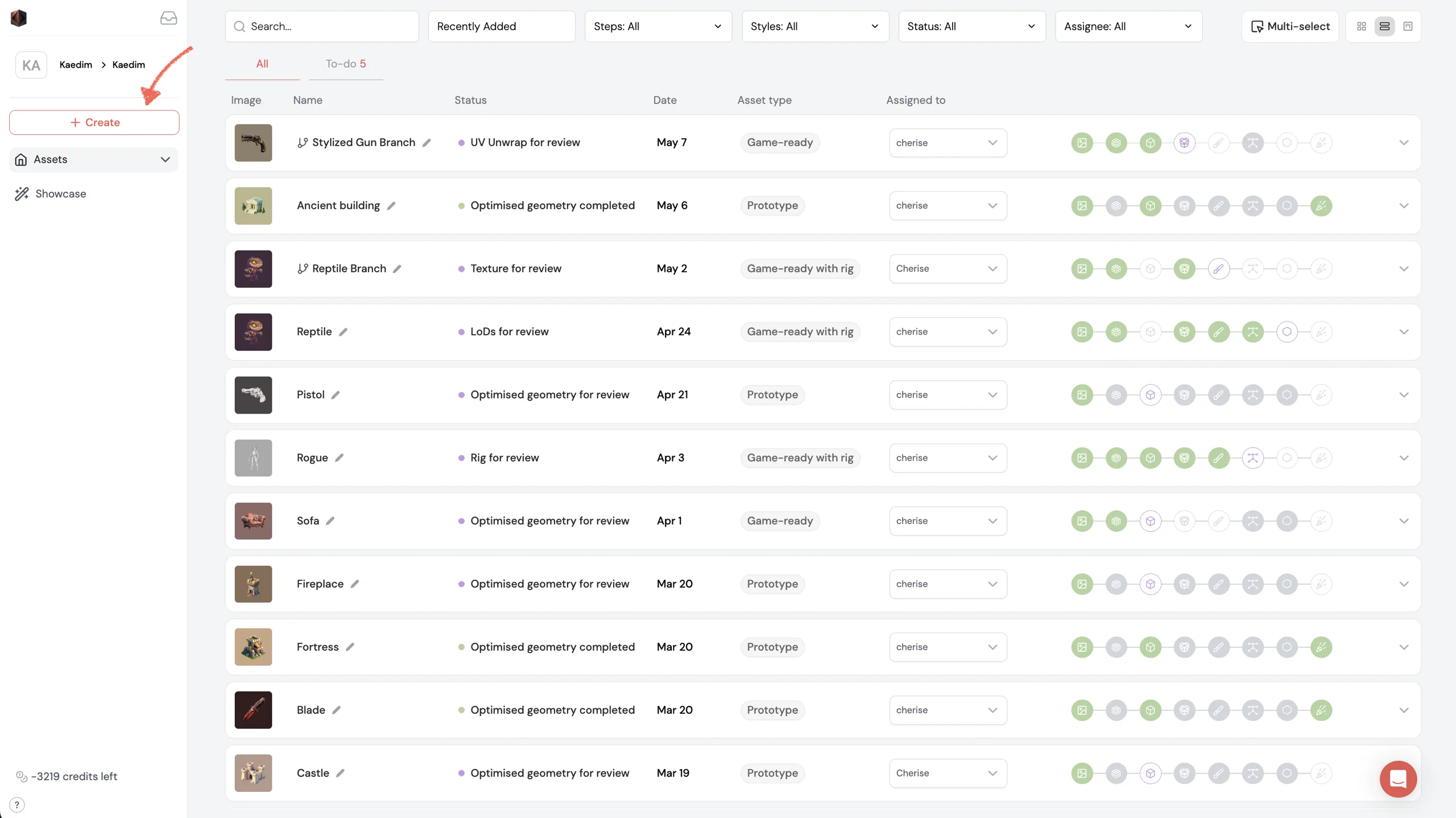
Kaedim's quick-start guide shows an asset list with production stages and review progress.
This review covers a bounded game-asset order from reference preparation through staged review and target-engine acceptance. It does not rank Kaedim against automatic generators or estimate studio-wide outsourcing replacement.
Beginner scope: A first bounded static prop or environment module for someone who can prepare clean references and has access to basic 3D or engine review; not a release-ready hero character from one image.
Agent scope: Codex, Claude Code or another external orchestrator submits a bounded Enterprise image-to-geometry task, persists the result and starts a separate validation pipeline; not autonomous control of every human-assisted production stage.
Confidence: learning Medium · Agent High
These are independent editorial judgments, not an overall score or a claim of hands-on agent integration testing.
KEY FINDINGS
Kaedim now explicitly combines proprietary AI with internal artists or an Art Lead who checks and adjusts each delivery before customer approval. This explains both the production framing and why comparing only generation prices is misleading.
O01O03O04U09Prototype delivers geometry. Game-ready can add optimization, UVs, textures, rigging, baking and LODs through sequential stages. A result must be described by the stages actually included—not by a generic '3D model' label.
O06O07O08O09Current pages disagree on whether trial access is paid or free, whether Indie includes a game-ready asset, and whether the customer needs DCC polishing. We preserve all three conflicts and recommend checking checkout or obtaining written confirmation.
O02O03O06O11O18Users reported high reference fidelity, low fidelity, useful topology, platform instability and different results across character and building tasks. Most detailed reports predate the current service positioning, so they establish risk themes rather than 2026 quality.
U01U02U03U04U05U06U07Enterprise clients can submit image-to-geometry jobs and retrieve files through status checks or webhooks. Public documentation does not establish programmable markup, artist review, all game-ready stages, revisions and approvals, and no official MCP was located.
O08O13O14O15O21The vendor says subscribed users own outputs, receive commercial rights and do not contribute project assets to shared model training. Yet a readable current Terms page was not located, the privacy policy is marked 2021, and human artists review assets; unreleased intellectual property needs project-specific terms.
O01O03O11O17EDITORIAL VERDICT
Consider Kaedim when a defined asset is valuable enough to justify a high cash entry point and your team can specify and accept 3D work. The human-assured, approval-led service may be more useful than repeatedly drawing cheap candidates, but current independent evidence is too old and sparse to promise quality, speed or return on investment.
BETTER FIT
POORER FIT
WORKFLOW FIT
Name the asset, target engine, scale, polygon range, topology, mesh split, UV and texture needs, rig template, LODs, collision, naming and file formats before ordering.
Use one object on a clear background, add orthographic front, side, back, top and bottom views where possible, and separate complex accessories instead of hiding them in one silhouette.
Use prototype geometry for shape and direction. For a production asset, list the exact optimization, UV, texture, rig, bake and LOD stages required and confirm that the chosen plan includes them.
Annotate visible issues before approving each stage. Download the final files promptly, import them into the real DCC and engine, and check materials, collision, skeleton, deformation, frame budget and gameplay behavior.
RECOMMENDED WORKFLOW
Start from a testable brief, then move through prototyping, assets, audio, testing, and release with an explicit handoff and human check at every step.
SHORTEST RESPONSIBLE PATH
This is a low-risk starting workflow synthesized from the evidence.
Choose one static prop or environment module whose concept is already stable; avoid a hero character for the first order.
Prepare three to ten clean views and a one-page technical acceptance sheet for the target engine.
Recheck the live checkout, automatic renewal and exact stages included in Trial or Indie; save the terms shown at purchase.
Order prototype geometry first when shape or reference interpretation is uncertain, then decide whether an upgrade is justified.
Comment on each stage before approval, using the written acceptance sheet rather than general visual preference.
Import the result into the real project, measure integration and correction time, and divide total spend by assets that actually pass before scaling.
PRICING & RIGHTS
Pricing and terms last checked: Sep 12, 2026
Arithmetic from the maximum capacities on the September 12, 2026 plan page. It excludes unused capacity, quality tiers, Enterprise terms, input preparation, waiting, revisions, DCC/engine integration and acceptance failures.
O02O06O07O08O11O12O18That is a nominal $10 per geometry only when all five published capacity units are usable. The route automatically renews to Indie unless cancelled.
Nominally $20 per geometry or $400 per complete asset. Public documentation conflicts over whether Indie receives the full game-ready path.
The nominal unit prices remain $20 and $400. Priority processing does not establish delivery time, first-pass acceptance or engine readiness.
Indie needs ten monthly capacity blocks. Pro needs four and leaves room for twelve assets. This illustrates monthly rounding, not delivery concurrency, schedule or accepted quantity.
Current public evidence does not provide comparable acceptance rates, correction hours or exact entitlements, so a reliable cost per accepted geometry, complete asset, rigged character or scene cannot be calculated.
Actual accepted-asset cost = subscription or contract, reference preparation, revision and waiting time, DCC and engine integration, materials, rigging, collision, performance work and QA divided by assets that pass the project's bar. Keep that number unknown until your own fixed task is measured.
Commercial use appears allowed with conditions. Kaedim says subscribed users own generated models, receive full commercial rights and do not contribute project assets to shared model training. However, a readable current Terms text was not located, input rights remain the uploader's responsibility, and exact Indie deliverables conflict across public pages. Save the purchase terms and obtain current contract language for important work. This is not legal advice.
Human artists or an Art Lead inspect and adjust assets. The visible privacy policy is marked April 14, 2021 and does not place the current asset workflow, personnel access, subprocessors, project-file retention and deletion terms in one complete statement. Treat unreleased characters, brands and art bibles as confidential and settle access, retention, deletion, security, refunds and automatic renewal in writing.
PRODUCTION RISKS
Trial price, Indie game-ready access and customer cleanup have incompatible public descriptions. Check the live checkout and request written deliverables before paying; screenshots of a marketing page are not a contract.
O02O03O06O11O18Single-view silhouettes, cluttered backgrounds, hidden sides and combined accessories create ambiguity. Validate references and prototype shape before committing a complete-asset slot.
O05O10U01U02U07A visually approved FBX or GLB can still fail scale, material, collision, skeleton, deformation, naming or performance requirements. Keep a target-build gate after the Kaedim workflow.
O08O09O11Detailed user outcomes are mostly old; recent identifiable comments lack inputs, files and acceptance results. Do not infer a 2026 success rate, revision speed or comparison rank from vendor cases or aggregate ratings.
O19O20U01U02U03U04U10Authentication renewal, webhook validation, one-hour result URLs, persistence, retries and quality gates belong to the caller. Public API pages do not expose the complete artist-review and approval loop.
O13O14O15O21NOT VERIFIED
RESEARCH METHOD
Research-reviewed from public evidence. We checked twenty-one official product, plan, workflow, API, integration, ownership and privacy sources, then coded ten principal external records across Product Hunt, Trustpilot, Reddit, independent reporting and an identifiable studio comment. Product Hunt and Trustpilot each contribute three of ten; no platform exceeds 30%. Positive, negative, mixed and disclosure evidence is retained, but most detailed outcomes are from 2022–2024 and vendor cases are not counted as independent quality evidence. No account, payment, upload, model generation or Enterprise API call was made or required.
Current positioning, ownership, security and shared-model-training claims.
Current Trial, Indie and Pro prices, credits, capacity and automatic renewal.
Artist-assured workflow, Enterprise scope, commercial claims and no-cleanup statement.
Documentation entry and human-in-the-loop product overview.
Asset submission, multi-view upload and review flow.
Prototype, game-ready, rigged and scene deliverables, including the conflicting plan-access statement.
Prototype geometry quality levels, settings, credits and processing estimates.
Game-ready settings, revisions, optional stages and processing estimates.
The sequential high-poly, optimization, UV, texture, rig, bake and LOD workflow.
Reference-image requirements, orthographic views and complex-object limits.
Formats, intellectual property, polishing, revisions and the no-free-trial statement.
Credit schedule and Enterprise access context.
Enterprise-only authentication, generation request, status, webhook and result-download contract.
API and user-generated-content integration overview.
Plugins, scripts, automation and custom Enterprise integration scope.
Documented Unity plugin handoff and import workflow.
Privacy policy marked last updated April 14, 2021.
Game-team workflow and the conflicting first-three-assets-free statement.
Public documentation release history.
Vendor-selected game-studio workflow and savings claims; not independent quality evidence.
Official public API example with a thin repository history and no releases.
A simple-character attempt reported a long wait, low reference fidelity and unfinished fingers.
A detailed multi-view character was reported near the reference and expensive but worthwhile.
A historical report of upload and generation instability.
A self-described 2D designer reported that submission and revision tools helped them begin 3D work.
A promotional-sounding one-review account reported useful topology, detail and hours saved; weighted low.
A basic-sketch character attempt reported satisfaction without downstream details.
One user reported good character topology but poor results for a Paris building facade across three runs.
A user expected a free trial but encountered a payment request; unsupported accusations are excluded.
Independent reporting on earlier human involvement and disclosure; current pages now state artist assurance.
A recent identifiable studio comment praised the collaboration but supplied no task or acceptance detail.
DISCLOSURE
Independent editorial research. MakeGameWithAI has no affiliate link, sponsorship, vendor-provided account, free credits, asset generation, interview or technical support for this review. Owner Review approved the managed-service positioning, some_basics / medium beginner decision, limited / high external-Agent decision, nominal cost framing, commercial and data boundaries, and three-conflict disclosure on September 12, 2026, then approved publication on September 14, 2026.
This public research review will be revisited when pricing, terms, product versions, or material new evidence changes.