Text and reference-led images
Describe a subject, style and composition, or use an image you have permission to upload. Select a model and inspect its available controls.
O01O02Start with an idea, explore visual directions, then refine the images your game needs.
PRODUCT OVERVIEW
Leonardo.Ai is a cloud-based visual creation platform. In a browser, you can turn a description or reference image into character concepts, props, backgrounds or illustrations, then edit, enlarge and download selected results. You do not need to draw the first version yourself or deploy an image model to get started.
It brings its own models and third-party models into one workspace. Image Creation offers model and generation settings; Flow State focuses on exploring many directions and making variations of an image you like. Reference controls, editing options and costs depend on the chosen model, so these are different routes rather than one uniform generator.
For game development, its clearest role is producing static-art candidates and visual references. Downloaded images can move into an art editor or your project, while an official API can automate generation and retrieval. Preparing transparent edges, sprite frames, engine settings and a consistent finished asset set remains separate work. The wider platform also offers other media; this review focuses on 2D images.
Use the browser workspace with an account and available tokens. For automation, configure a Production API key and separate API balance; REST, official SDK methods or the documented MCP can be wrapped into an external agent workflow.
Describe a subject, style and composition, or use an image you have permission to upload. Select a model and inspect its available controls.
O01O02Explore candidates and use More Like This to pursue a direction. New results consume tokens even when you do not save them.
O05Refine selected images with supported edits or upscaling. Paid personal-model training is an advanced option, not a prerequisite for your first image.
O01O04O06Keep useful results and download image files. Personal trained models are not downloadable, so asset portability and model portability differ.
O02O04REST covers generation, status and result URLs. The official MCP documents generate-image for Lucid Origin, Lucid Realism and Ideogram 3.0—not every Web feature.
O16O17O25INTERFACE & EXAMPLES
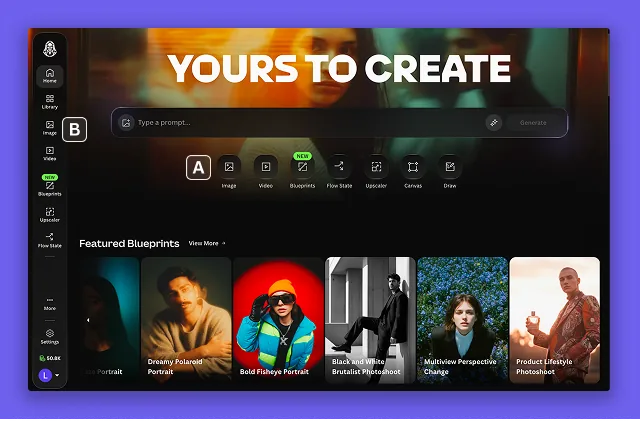
Leonardo's official quickstart shows the prompt entry, creation tools, and featured Blueprints on the home screen.
Basic non-confidential 2D creation and external generation/retrieval. Full animation consistency, 3D/video quality, runtime generation and production reliability are outside this assessment.
Beginner scope: A browser user's first non-confidential 2D concept, character or prop candidate set, without a professional drawing background.
Agent scope: An external agent submits a 2D image generation, waits for the task and retrieves the resulting files; not development of an entire game.
Confidence: learning Medium · Agent Medium
These are independent editorial judgments, not an overall score or a claim of hands-on agent integration testing.
KEY FINDINGS
A character-development thread and a hands-on article describe reference-led iteration and browser exploration. They support the starting workflow, while a paid user's settings complaints show that learning and budget checks remain part of it.
O02U03U05U06One developer reports using Leonardo for game imagery; an older Polycount project used it for magazine-cover art in a prop pack. These are scoped project accounts, not proof Leonardo produced the entire game or asset pack alone.
U02U04A GameDev.net author describes an unsuccessful multi-frame attempt involving Leonardo and Copilot. Its year and per-tool results are unclear: it is a caution about the task, not a current Leonardo failure rate. A successful static iteration does not establish matching motion frames.
U01U03The official REST flow returns a generation ID, exposes task status and provides image URLs. That is enough to support a scoped integration judgment. The MCP covers fewer models; neither the API documents nor this review guarantee every client's reliability.
O16O17O18O25EDITORIAL VERDICT
Leonardo is a useful starting route when you have a game-art idea but cannot yet draw or configure a local image workflow. You can see alternatives early, choose a direction and keep improving it. Treat the result as a candidate to inspect, not a finished asset by default. Its official programmatic entry also makes it relevant to agent-assisted development, provided you account for separate API spending and the chosen model's limits.
BETTER FIT
POORER FIT
WORKFLOW FIT
Generate a few directions for one prop or background, select a promising silhouette or palette and keep the reference.
Use supported reference/edit controls, then inspect the downloaded file at the size it will occupy in your game.
Wrap the official API to submit a bounded request, retain its ID, await completion and save the returned image into a staging folder.
RECOMMENDED WORKFLOW
Start from a testable brief, then move through prototyping, assets, audio, testing, and release with an explicit handoff and human check at every step.
SHORTEST RESPONSIBLE PATH
This is a low-risk starting workflow synthesized from the evidence.
Choose one original, non-confidential visual idea; a finished animation set is not the first task.
Check available tokens, the active model, output count and public/private setting before submitting.
Generate a small candidate set, pick one direction and request a specific refinement.
Download useful results, inspect them at game size and record the settings and rights context.
Only then consider paid volume or API automation; confirm the actual billing and model-specific terms before committing.
PRICING & RIGHTS
Pricing and terms last checked: Sep 7, 2026
Illustration only: Essential's officially stated yearly rate ($10/month equivalent, 8,500 monthly tokens) and Flow State at 1 token per new image. A workflow is 8 initial candidates + 8 similar variants, with existing results saved/downloaded. No other edits or upscaling are included.
O05O06O07O08O20O23$10 ÷ 8,500 × 1. This is an allowance allocation, not a cash price at which one image can be purchased.
$10 ÷ 8,500 × (8 + 8) ≈ $0.018824. New images consume tokens whether you keep them or not; saving existing results does not add this charge.
floor(8,500 ÷ 16), if every monthly token goes to this exact workflow. These are candidate sets, not 531 accepted assets. Annual billing does not imply all annual tokens arrive at once.
Standard generation, a chosen edit and an upscale need their own quotes; the 1-token rate cannot be reused. Accepted-asset cost also includes discarded attempts and human work. API pricing is separate.
The example requires an annual commitment of $120 before applicable tax, not a $0.019 purchase. Amounts retain the site's $ notation; checkout currency, regional charges and payment were not verified. Unused allowance, extra features, retries and cleanup increase effective cost. This is not a recommendation to buy annually or a promise of usable assets.
Official help permits commercial use of free Web output, but the Terms assign its output rights to Leonardo. Paid output rights vest in the user only to the extent the law permits. Public content carries broad reuse permissions; paid private content has narrower service-processing terms. Check Private Mode and input rights. API trial/PAYG-only status and third-party/Beta conditions need separate confirmation; commercial permission is not a copyright or non-infringement guarantee.
Check the applicable plan and contract before purchase or commercial release. Web subscription, API usage and the external agent's own model costs are separate; do not infer a refund for every discarded or failed result.
PRODUCTION RISKS
Check the actual public/private setting before uploading. The private-content training restriction is not a zero-retention or local-processing promise; cloud providers, records and contractual exceptions still matter.
O10O14A paid user reported unexpected submissions and changed settings. That is a dated account, not proof of a current universal bug. Recheck model, size and quote each time; top-up consumption-order conflicts remain unresolved.
O08O11U06Use a controlled local tool or server for paid requests. Save the generation ID and inspect status: an empty result while pending is not a reason to repeatedly submit another paid generation. Clients need error handling and spending controls.
O16O17O21Inspect edges, text, visual scale and repeated character details in context. A personal trained model cannot be downloaded, and neither a successful image nor an old asset-pack case proves an entire current animation pipeline.
O04U01U02U03NOT VERIFIED
RESEARCH METHOD
Six concrete usage accounts across GameDev.net, Polycount, Reddit and iXBT; Reddit supplies three of six. Forum records and an independent walkthrough cover project use, iteration and friction. A historical asset pack and an undated mixed-tool animation failure retain those limits. Vendor tutorials, duplicated posts and unreadable review summaries were excluded. No generation, model training, engine import or authenticated API/MCP call was performed.
Product scope; vendor quality and productivity claims are not independent evidence.
Browser generation, settings, the displayed token quote and downloads.
Basic access, model portability, content rights and separate Web/API plans; older payment details are not a current guarantee.
One token per newly generated image; saving existing results is free. Free-use limits apply; contradictory toggle directions are not repeated here.
Current tier names, allowances and features. Billing-toggle state was not interactively verified; the page omits unverified monthly quotes.
Only the clearly labelled Leonardo yearly pricing is used. Competitor comparisons and claimed winners are excluded.
Task-dependent metering and restricted relaxed generation; one token is not a universal image price.
Rollover bank caps and the effects of plan changes; unused allowance is not unlimited savings.
Terms dated January 19, 2026: free/paid output rights, public/private processing, subscriptions and Beta conditions.
Active-subscription requirement; conflicting consumption-order text remains unresolved.
Self-serve API and vendor commercial/privacy statements. Trial and PAYG-only rights are not assumed identical to paid private Web rights.
Commercial permission for free and paid outputs does not mean identical ownership or exclusivity.
Policy dated January 19, 2026; service processing, sharing and retention must be distinguished from training controls.
Production API key, Bearer authentication, separate billing and generation ID after submission.
Pending/completed/failed states and result URLs; an empty image array may mean the task is still running.
Documented generation and lookup methods; inspected as documentation, not installed or executed.
API balance and self-serve top-ups are separate from the Web token subscription.
Current PAYG versus legacy plans and optional automatic top-ups; example amounts are not task quotes.
The linked calculator required login; no authenticated model-specific task quote was obtained.
Remote MCP, API-Key header and one documented generation tool covering three models; client compatibility was not tested.
Year unknown. A multi-frame attempt using Copilot and Leonardo did not satisfy the author; separate tool results are unclear. The sketch is hand-drawn, not AI output. Vendor relationship unknown.
August 2023 historical asset-pack project using reference-led magazine art. The author promotes the pack; other tools also contributed. Not a current-model benchmark; vendor relationship unknown.
August 2026 character iterations from original artwork with Nano Banana. The author promotes a game in development; v4 is not proof of only four attempts. Release use and vendor relationship unconfirmed.
March 2026 self-reported mixed-tool game project. The author clarifies static images and short video, not Leonardo 3D models. This page uses the static-art account; the game was not run. Self-promotion; vendor relationship unknown.
Paid-account walkthrough of prompts, visual errors, Flow State and selection. Old plan names and subjective model rankings are excluded. Media commercial relationship unknown.
March 2026 paid blog-illustration user reports accidental submissions and setting changes. Not a game task or proof those issues persist today; vendor relationship unknown.
DISCLOSURE
No affiliate link, sponsorship, supplied account or gifted credits were used for this review. Some sources promote their own projects, and their vendor relationships are unknown. The research and both scoped selection judgments passed Owner Review on September 7, 2026.
This public research review will be revisited when pricing, terms, product versions, or material new evidence changes.