Create a character and start talking
Choose a backstory, style, language and voice in the browser, then refine the result through text or voice conversations. Unlisted visibility is not the same as Private.
O03O04Start with a character idea, then bring a talking NPC into your game.
PRODUCT OVERVIEW
Convai is an online character-creation and runtime service. Write a character's identity, background and speaking style, choose its language and voice, then talk to it in the browser. It generates responses to player input rather than simply helping you write a fixed script.
Unity and Unreal SDKs connect that character to a game, including input, speech and configured actions. You still supply the scene, avatar assets, rules and permitted behavior. A character can respond to game-provided state or request an action; it does not automatically know every quest, inventory item or save value.
This gives beginners a practical first step without building the speech and language stack themselves. Start with one guide, tavern character or quest helper, learn through conversations and play, then add the game logic you need. Coding and engine judgment improve control as the project grows; they are not qualifications for beginning in the Playground.
Start with an account and a browser character. For game integration, install the matching SDK and use a small sample scene. Unity 4.5.0 requires Unity 6000.0.80f1 or newer; Unreal 4.0.0-beta.27 remains beta. AI-assisted configuration can help, but follow the current documentation rather than an older tutorial.
Choose a backstory, style, language and voice in the browser, then refine the result through text or voice conversations. Unlisted visibility is not the same as Private.
O03O04Knowledge files describe the world; dynamic context carries game state and events; paid long-term memory links sessions to stable player and character IDs. These are different from an authoritative save system.
O02aO10O11Configure look, gesture, walk or follow behavior and guide narrative goals. Walking needs navigation setup, and quest changes still need game rules. Some controls currently point to Legacy Playground.
O03O09O15Use the SDK in your own game, or explore Convai's hosted Avatar Studio/Sim route. They share some service concepts but cloud-rendered minutes and cloud-experience concurrency are separate limits.
O02aO08O14O23INTERFACE & EXAMPLES
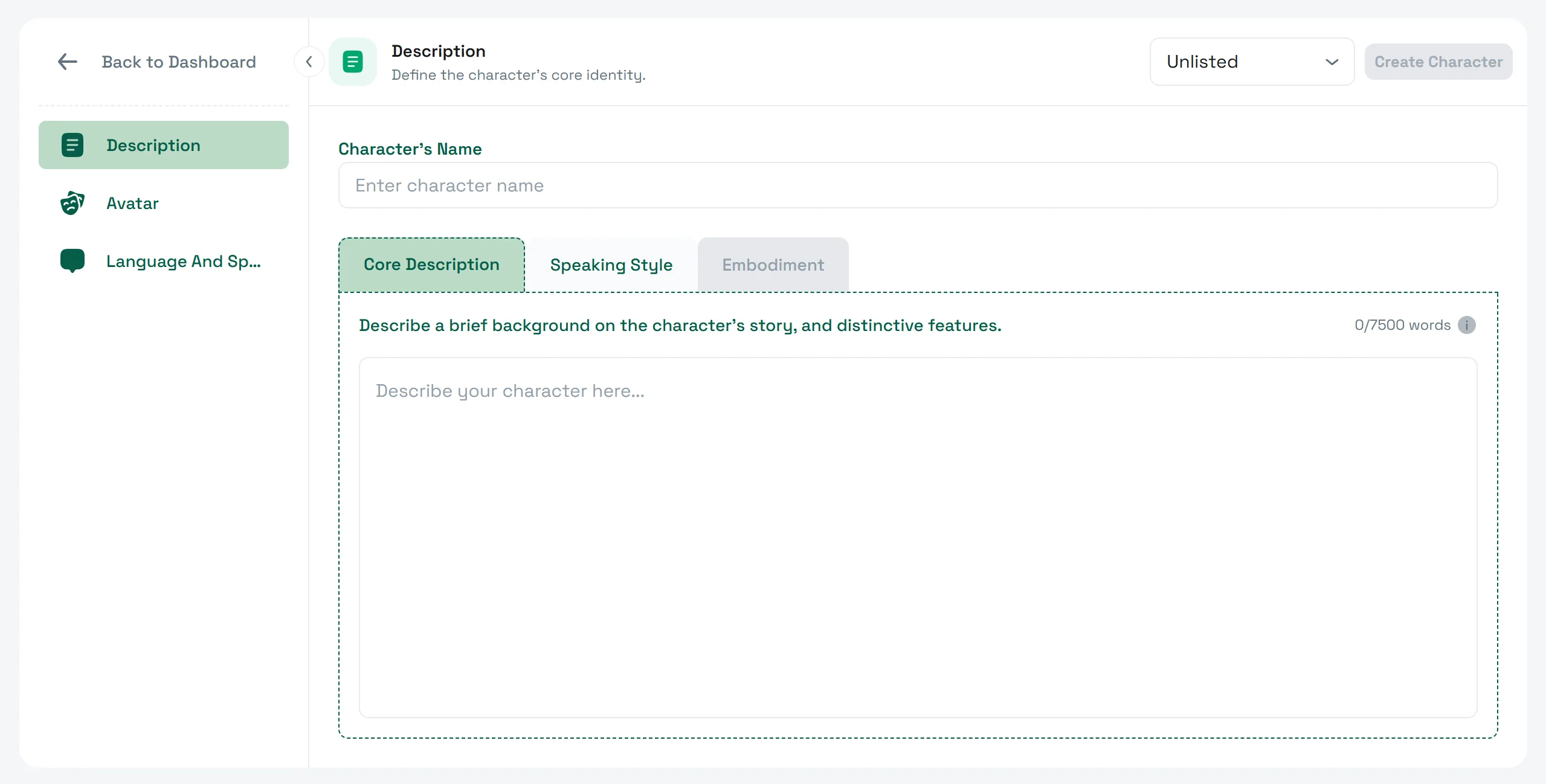
The character editor separates the core description, speaking style, and embodiment settings.
A first talking NPC, a small game prototype and understandable ongoing costs. Public cases show useful routes, not current-version guarantees for Chinese dialogue, latency, concurrency, narrative accuracy or a complete commercial game.
Beginner scope: Create and test a first web character, not immediately ship a networked NPC game.
Agent scope: Send a conversation turn to a configured character and receive text responses.
Confidence: learning Medium · Agent Medium
These are independent editorial judgments, not an overall score or a claim of hands-on agent integration testing.
KEY FINDINGS
The browser workflow lets you create and talk to a character before learning engine integration. SDK samples, configured actions and AI-assisted setup provide further entry points. The evidence supports trying a first interaction, not a promise that every beginner can ship without learning or help.
O03O04O09O18O23A Unity/Quest creator reports a usable project with improved reliability. TUMSphere built a campus VR guide, while an iOS developer eventually resolved custom-build connection issues. These are different projects and conditions; the campus study used a PC-linked headset, not standalone Quest hardware.
U02U03U04The limit applies to actively connected sessions sharing the deployed API key, not how many character definitions exist. Different players or characters can draw from the same pool. Creating extra NPCs does not create extra concurrency, and a second-character setup problem is not proof of a one-NPC product limit.
O02aO02bU07One older Unreal report describes variable waits and a short outage that later recovered; a different Unity/Quest project in the same discussion reports improvement with a modified audio setup. The study uses another measurement definition. Version, voice, model, context and network differ, so these reports are not a common benchmark.
U01U02U04Knowledge, memory and narrative goals help give a character context, but the campus study still reports invented information. Treat generated actions as requests that the game validates. Inventory, rewards, payments and saved progress should not change merely because an NPC says they should.
O09O10O11O15O16U04EDITORIAL VERDICT
Convai is worth considering when you want a character that responds to players before you know how to build an entire voice-and-language system. Its browser entry point and engine components make that idea approachable, and public projects show that it can go beyond a standalone chat window. Begin with one character and one useful interaction. Let game code control consequential actions, and budget for real players and simultaneous sessions before widening access.
BETTER FIT
POORER FIT
WORKFLOW FIT
Give a guide or quest helper a short role and a few facts it should know. Try ordinary questions and questions outside that role; use the answers to refine the character before building a larger scene.
Use the matching SDK sample, connect one NPC and configure a gaze or gesture. Add walking, game events and narrative conditions only when the first loop is understandable and useful.
Choose a small audience and track distinct players, visits, active connections and voice/model use. Evaluate the target build, not only the editor, and use the measured workload to revise the budget.
RECOMMENDED WORKFLOW
Start from a testable brief, then move through prototyping, assets, audio, testing, and release with an explicit handoff and human check at every step.
SHORTEST RESPONSIBLE PATH
This is a low-risk starting workflow synthesized from the evidence.
Create a non-sensitive Playground character, start with text, then try voice. Prepare a small set of questions including ones it should decline or admit it cannot answer.
Install the SDK for your engine version in a disposable project copy. Connect the sample character before adding custom scene components.
Add a look or gesture action and one game-state input. Validate quest completion and rewards in game logic, with a scripted fallback.
Build for the intended device and invite a limited group sequentially. Record actual quota changes and active sessions before proposing a larger player budget.
Before public access, check short-lived credentials, player notices, visibility, attribution and account caps. Do not turn a successful editor conversation into a performance guarantee.
PRICING & RIGHTS
Pricing and terms last checked: Aug 31, 2026
Illustrative monthly USD allocation, not observed billing: assume one ten-minute visit and two generated replies per minute, so 20 interactions per visit. Except the cloud example, use your own engine renderer with regular models/voices. Exclude retries, other use, tax, external services and labor. An interaction is an input plus generated response, not a minute or an accepted gameplay task.
O02O02aO02bO213,000 interactions, 75 MAU and one active character session. $29 ÷ 3,000 ≈ $0.0096667 per interaction as nominal allocation. You still pay the full $29; you cannot purchase only the fraction you use.
20 × $29 ÷ 3,000 ≈ $0.19. The total quota suggests 150 visits, not 150 different players: MAU is 75 and sessions run one at a time. All-flagship use covers at most 75 visits; included HQ voices cover 25, before other usage.
Assume 100 preparation interactions + 10 × 20 for sequential visitors. The actual monthly payment is still $29. Quota alone fits 10 such workflows, but one creator plus new groups of ten people fits only 7 complete groups within 75 MAU. The 100-interaction preparation budget is an assumption.
100 × 10 × 2 = 2,000 interactions. Indie has enough interactions but not enough MAU. Professional is the lowest published monthly plan meeting these conditions: $19.80 nominal allocation, but $99 cash paid, or $0.99 per person if these are the only 100 users.
The workload remains 2,000 interactions, but Professional permits only three active character sessions. Scale meets the stated cap: $19.96 nominal interaction allocation versus $499 paid, or $4.99 per person. This is plan matching, not a latency or throughput guarantee.
For the same 100 ten-minute visits, Professional's 2,400 cloud minutes cover visits alone; editing adds usage. Its cloud-experience concurrency is only one, not three. Three simultaneous cloud experiences require a plan such as Scale under the same assumptions.
Theory is not accepted output. At one, two or four replies per minute, the ten-minute Indie allocation is about $0.09667 / $0.19333 / $0.38667, while its MAU cap still applies. None of the listed monthly plans covers 100 active character sessions at once; confirm a custom arrangement rather than extrapolating a per-interaction price. Actual accepted-conversation cost must include real subscription spend, external services, hosting, iteration and operations, divided by conversations that meet your criteria; that result is unknown.
The terms leave ownership of customer and generated content with the customer, but input rights, third-party voices/avatars and content restrictions still apply. Making the service available to others requires attribution unless a written or white-label agreement waives it; the table lists custom branding on yearly Scale/Business. Creator data-use terms and Enterprise agreements differ. Approval of this review does not certify every game, asset or data practice as permitted.
Unused interactions do not roll over, and payments are generally non-refundable under the terms. No universal free-retry, failed-request refund, interrupted-response metering or automatic overage price was established. Confirm checkout, applicable caps and upgrade terms; spending more does not by itself establish faster responses.
PRODUCTION RISKS
Unity 4.5.0 starts at Unity 6000.0.80f1. The Unreal beta.27 matrix lists UE 5.0–5.8, with Win64/Android targets; its editor window needs 5.2+ and MCP tools need 5.8. Unity WebGL uses browser audio without Unity spatial audio, has documented lip-sync limitations, and needs microphone permissions. Older tutorials or issue reports do not establish current compatibility.
O06O08O12O13O14U05U06U07Creator terms allow customer and generated content to be stored and used to improve services unless agreed otherwise in writing; customer content includes player speech, text and scene information. Unlisted is not private, and Business is not automatically an Enterprise contract. For Unity, use the documented backend/short-lived-token path rather than shipping an obfuscated account key; handle player notices and consent.
O03O17O19O20Stable identity helps memory connect sessions, and game-supplied context helps the character track events. Neither makes generated statements authoritative. Custom guardrails API is paid, and the case study still reports invented information despite a knowledge base. Verify actions and keep fallback dialogue for important paths.
O10O11O15O16U04Limits, outages, SDK changes and external voices can affect access. The 2024 Convai Connect announcement describes a player-account partnership route, not a verified default way to make developer costs disappear. Its current availability and terms remain unknown. Limit exposure and keep the game understandable when its character cannot respond.
O02bO06O12O21O22U01U03NOT VERIFIED
RESEARCH METHOD
Seven independent cases across five platforms: Convai Forum, Epic Developer Community, GitHub, Reddit and an original Frontiers project study. The three evidence types are community reports, a technical issue and an academic project. Convai Forum contributes 3/7 (42.9%) and Reddit 1/7 (14.3%). Two authors describe different projects in the same forum thread; they count as separate cases, not separate platforms. The study counts once, not once per participant. Four records have explicit dates within the preferred year, one shows only '3mo ago', and two are historical. Searches also covered GameDev.net, Unity Discussions, note.com, Zenn and G2; weak, incomplete and derivative material was excluded. Staff source S01 is grouped with official material. We retained positive counterexamples and resolved outcomes, did not average stars or incompatible latency figures, and separated official facts, user reports and budget assumptions. Current exact-version evidence remains limited; workflow advice is editorial synthesis.
Current subscription entry point; the public table and FAQ are recorded separately below.
Public pricing-page data, not a checkout: USD prices, monthly quotas, MAU, two concurrency limits and feature subcaps.
Interaction and active-session definitions, no interaction rollover and flagship/HQ-voice limits; the Scale MAU example conflicts with the table.
Browser character setup and visibility; some actions/narrative controls still point to Legacy Playground. Unlisted is not Private.
Documented text, voice and debugging entry points. Reading this guide is not a first-party product test.
Package Manager and Asset Store routes, dependencies and configuration prerequisites.
4.5.0 dated August 14, 2026, with Unity 6000.0.80f1 minimum and migration changes. Older 3.x reports are not tests of this release.
Platform-specific paths and WebGL audio/microphone limits; documented support is not a compatibility test by this site.
Configured look, gesture, walk and follow actions; locomotion needs targets and navigation setup.
Paid cross-session memory depends on stable user and character identity; it is not a complete save system.
Game-provided state and events inform the character. A context acknowledgement is not proof of a gameplay action completing.
4.0.0-beta.27 dated August 11, 2026; beta and Blueprint changes remain material to upgrades.
UE 5.0–5.8 runtime table; editor window requires 5.2+, while MCP editor tools require 5.8.
Win64 and Android are supported targets in this release; macOS, Linux and iOS are not in its supported set.
Goals, sections, decision points and game-triggered events; not a guarantee of perfect story compliance.
Custom guardrails API is labeled paid; configuration does not establish zero hallucinations or universal safety.
Developer-backend and short-lived AuthToken route; obfuscating a shipped account key is not secrecy.
SDK-aware configuration tools can assist scene setup; this is not evidence of a beginner success rate.
Updated September 1, 2025: ownership, attribution, Creator data use, Enterprise agreements and payment conditions.
Page dated February 21, 2023; data categories, service providers and US processing. No blanket runtime-data deletion guarantee.
All Convai tiers may connect a key, but the current guide requires ElevenLabs Pro or above for 44.1 kHz compatibility.
March 18, 2024 announcement of a player-account partnership route. Current availability, SDK support and revenue terms were not established.
Character, player, room, input and sample-scene setup; a supported route rather than an audited game build.
April 2026 staff guidance about interface changes and retaining the logo; treated as vendor evidence, not an independent user vote.
March–April 2026, Unreal 3.6.8-beta.3, Business/Free comparisons. Reports variable waits and an outage that recovered that day; not a current-version benchmark.
A separate project in U01's thread reports improved reliability with a modified audio component and specific voice/model. SDK version and commercial ties are unstated.
Unity 4.0 to 4.1.0: samples worked but a custom TestFlight build failed. The author reports resolution on page 2 after preservation/audio-session changes; one case, not several votes.
TUMSphere's 24-participant campus guide used UE5, Convai and a Quest 3 linked to a high-end PC. One project, not 24 independent records; SDK/date of collection are unclear and hallucinations remain a limitation.
January 2025 historical report about location, gaze and button-dependent behavior; no confirmed resolution or exact SDK. Not proof of a current gaze defect.
March 2025, UE 5.5.4 and Quest 3 in the legacy repository. The team reports a workaround; an open issue is not proof that beta.27 still fails.
One character worked; adding another raised configuration problems and an AI-suggested setting could not be found. Exact date/SDK/plan and resolution are unknown; page showed '3mo ago' when checked.
DISCLOSURE
Owner Review passed on August 31, 2026, accepting this bounded public-evidence review. This work introduced no sponsorship, affiliate arrangement or vendor-provided credits, and involved no paid generations or engine tests. The owner's previous use and commercial relationships remain unstated; approval does not resolve the listed pricing conflict or unknown runtime performance.
This public research review will be revisited when pricing, terms, product versions, or material new evidence changes.