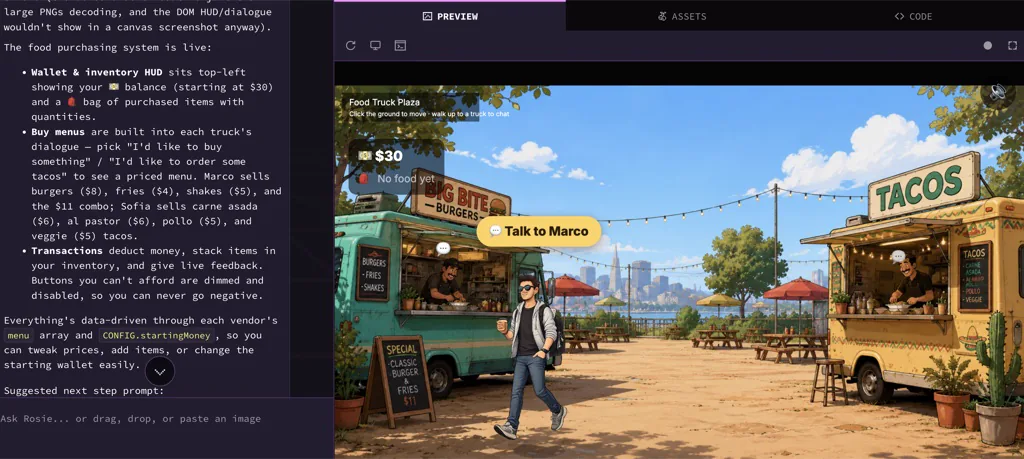
Describe or remix a starting point
Start with a template or a small game brief, then inspect the playable result. You do not need to build a local engine project first.
O01O02Turn a small game idea into something you can play, change and share.
PRODUCT OVERVIEW
Rosebud AI is a browser-based game-creation workspace. You describe an idea or start from a template, let its AI generate code and arrange assets, then play the result in a preview. The output is an interactive game—not just a design document or an image of a game.
Its product covers 2D and 3D games, with natural-language edits and asset upload or generation in the same workflow. A practical starting point is a small single-player game: movement, one interaction and a score or win/lose condition. Play it, describe what should change and build up the rules in small steps.
You can share a browser link, and official documentation describes a paid Windows build that includes editable source. Those files can support further development outside Rosebud, but they are not a native Unity or Godot project. Export permissions and the current commercial tier need checking before choosing a paid route.
Use the browser workspace and the account/allowance it requires. Check My Plan before relying on a free allowance, buying a subscription or planning a source/EXE download; the current prices and minimum eligible tiers were not confirmed.
Start with a template or a small game brief, then inspect the playable result. You do not need to build a local engine project first.
O01O02Request a rule, control or interface change, then check it in the preview. Small changes make it easier to notice regressions.
O13U01Upload or generate assets and use them in the project. Asset appearance, usage rights and gameplay behavior remain separate checks.
O02U01Share a Web link, or use the documented paid Windows route. Source files enable further editing, not guaranteed engine portability or agent access.
O01O07O08INTERFACE & EXAMPLES
The official editor image places the Rosie conversation beside a playable game preview.
A first small, non-confidential browser-game prototype and its iteration path. Commercial release, large projects, multiplayer backends, export reliability and performance are outside the supported conclusions.
Beginner scope: A first small single-player browser-game prototype for someone without a coding background, not a commercial-release pipeline.
Agent scope: An external agent calling the Rosebud creation service and obtaining the resulting game files.
Confidence: learning Medium · Agent Medium
These are independent editorial judgments, not an overall score or a claim of hands-on agent integration testing.
KEY FINDINGS
An independent walkthrough shows incremental 2D feature work, and a devlog describes a creator with limited coding knowledge starting with Rosebud. These support the entry point, not a promise that every beginner finishes a polished game.
O02O13U01U02Some authors continued in Cursor or Codex after the initial Rosebud work; another manually optimized a small game's performance. These are mixed-tool cases, not Rosebud-only production proofs or a current failure-rate estimate.
U02U03U07Official pages use both prompts and credits, and one guide contains incompatible Pro descriptions. We did not obtain the current My Plan table, so no historical price or allowance is presented as today's entitlement.
O03O04The documented Windows route provides source files, while agent-related articles and the research repository do not establish a callable creation service. Our public-source search found no confirmed API, MCP, CLI or SDK for creating, editing and retrieving Rosebud games.
O07O10O11O12EDITORIAL VERDICT
Rosebud is worth considering if you want to begin making a playable game without learning an engine or coding first. Its value is the short loop from an idea to something you can try and change. Keep that first project small, and treat source export as an optional next step—not a promise that complex development, commercial rights or automation are already solved. Before paying, resolve the plan conditions that matter to your project.
BETTER FIT
POORER FIT
WORKFLOW FIT
Start with movement and a single interaction, then add a simple score or ending so someone can play a complete loop.
Change one rule or interface element at a time and check existing behavior after each edit.
A shareable browser version may be enough. If you need source or Windows output, confirm the plan and then assess the actual exported project.
RECOMMENDED WORKFLOW
Three playable debugging exercises show how to describe a fault, limit an AI repair, check the result and recover a working version. Includes broken and fixed examples, six screenshots, templates and source.
SHORTEST RESPONSIBLE PATH
This is a low-risk starting workflow synthesized from the evidence.
Choose a non-confidential personal idea with one clear interaction.
Check the current allowance and relevant rights in My Plan before spending or uploading assets.
Start from a suitable template or describe movement, the interaction and a win/lose condition.
Play each revision and ask for one specific change; keep a working checkpoint.
Share the browser result first. Check source/EXE permissions, rights and actual output before committing to a paid migration.
PRICING & RIGHTS
Pricing and terms last checked: Sep 7, 2026
The representative task is a small single-player 2D prototype with movement, feedback, a feature revision and a shareable result. Current price, allowance and task consumption are not jointly verified, so no numerical output promise is made.
O03O04O07U02Nominal allocation = monthly price ÷ included credits × task credits. The current inputs are missing; one prompt is not a fixed-cost game.
Include first generation, revisions, assets, debugging and any build charge. Theoretical runs = floor(available credits ÷ workflow credits), not accepted games.
Add rejected attempts, human time, other coding tools, purchased assets and hosting. Mixed-tool project spending cannot be treated as a Rosebud-only average.
Historical prices are deliberately omitted from this page. Even a verified credit allocation would not establish quality, an acceptance rate or the number of release-ready games you will obtain.
The Terms restrict free use to personal, non-commercial purposes. Paid commercial permission is not the same as exclusive ownership: the Terms and ownership FAQs differ, and the minimum commercial tier remains unconfirmed. Check the applicable terms before selling a game.
Use My Plan and the applicable contract to resolve the tier, export and rights conditions first. A payment or an export alone is not proof that every asset is licensed or a release is ready.
PRODUCTION RISKS
The Privacy Policy covers prompts, code, media and logs, with the same practices for free and paid users. It permits anonymized/aggregated data uses including external training and research; do not assume a subscription provides a no-training guarantee.
O05O06Commercial permission, output ownership and rights to uploaded assets are separate questions. Resolve conflicting wording before depending on exclusivity or client confidentiality.
O05O09An EXE does not repair gameplay or packaging issues. Older export complaints predate the new guide; they justify checking your own files, not claiming the current exporter is broken. Networked features can still need external services.
O07O08U04The Terms restrict automated access. No documented external task interface was confirmed; this page does not recommend session-cookie reuse, reverse-engineered endpoints or bypassing the normal access path.
O05O10O12NOT VERIFIED
RESEARCH METHOD
We checked nine platforms and retained six concrete usage accounts plus one public-source artifact across note.com, itch.io, Reddit, GitHub and Hacker News. Reddit supplies three of the six usage accounts; multiple subreddits are one platform. GameDev.net and engine forums were searched but did not add completed-use records. Vendor interviews, same-name products and unverifiable summaries were excluded. Older and undated cases support bounded workflow observations, not current quality consensus. No product generation or export was performed.
Browser creation, templates, playable 2D/3D games and sharing. Vendor production-volume and quality claims are not independent evidence.
Describing a game, editing features, working with assets and previewing the result.
Directs readers to My Plan for current plans. Its older prompt allowance and commercial-tier wording do not establish a complete current tariff.
The same page contains incompatible Pro prices and credit-versus-unlimited-prompt descriptions. None is presented here as a verified current quote.
Revised August 2, 2025. Free/commercial use, generated-content ownership, non-confidential content, platform permissions and automated-access restrictions.
Revised July 25, 2025. Covers prompts, code, media and logs; paid use is not a blanket no-training or confidential-processing promise.
A paid-plan cloud-build route delivered by email, including supporting files and editable source. The lowest eligible tier and actual build behavior were not verified.
Windows packaging and further source editing. This is not a native Unity/Godot project or a guarantee of offline operation for connected features.
Editable browser code and an ownership FAQ whose wording must be read alongside the Terms.
Official agent-related positioning, not a documented API, MCP server, SDK or installable task CLI.
Technical articles and maintenance signals, not a public service-integration contract.
Identifies itself as a Rosebud AI research benchmark. It calls other model services and is not a client for the hosted Rosebud game creator.
Small changes, play checks and checkpoints. A vendor-described starting workflow, not a MakeGameWithAI test.
Shows feature revisions, character changes and imported music; names Sonnet 4.5 at that time. The author's plan and vendor relationship are unknown; the video mirror is not another record.
The author reports limited coding knowledge, starting with Rosebud and continuing with Cursor and purchased assets. Self-promotes the game; vendor relationship is unknown. Total project spending is not a Rosebud-only bill.
A self-promotional author account describes moving from RPG Maker to Rosebud and then exported-source work in Codex. Exact date, plan and model are unconfirmed. A demo is not a verified full commercial release.
Indexed April 21, 2026; reports credit frustration and export issues before the May Windows guides. Plan and relationship are unknown; it does not establish a defect in the current export path.
A 2025 author report describes workable first-pass logic but inconsistent visuals. Exact date, plan and relationship are unknown; unmatched trials are not a controlled ranking or current-model test.
A developer's HTML/JavaScript project credits Rosebud alongside other tools. It is an interactive experiment, not a complete game or measured export test; plan/date and vendor relationship are unknown. The author promotes their own work.
The author used Rosebud and ChatGPT, then manually optimized performance on a laptop. A historical mixed-tool case with promotion of the author's book; plan, coding background and vendor relationship are unknown.
DISCLOSURE
No affiliate link, sponsorship, supplied account, credits or vendor support was used. Some authors promote their own games, tutorials or books; vendor relationships are unknown. Owner Review of the research and both scoped decisions passed on September 7, 2026; pricing gaps remain.
This public research review will be revisited when pricing, terms, product versions, or material new evidence changes.
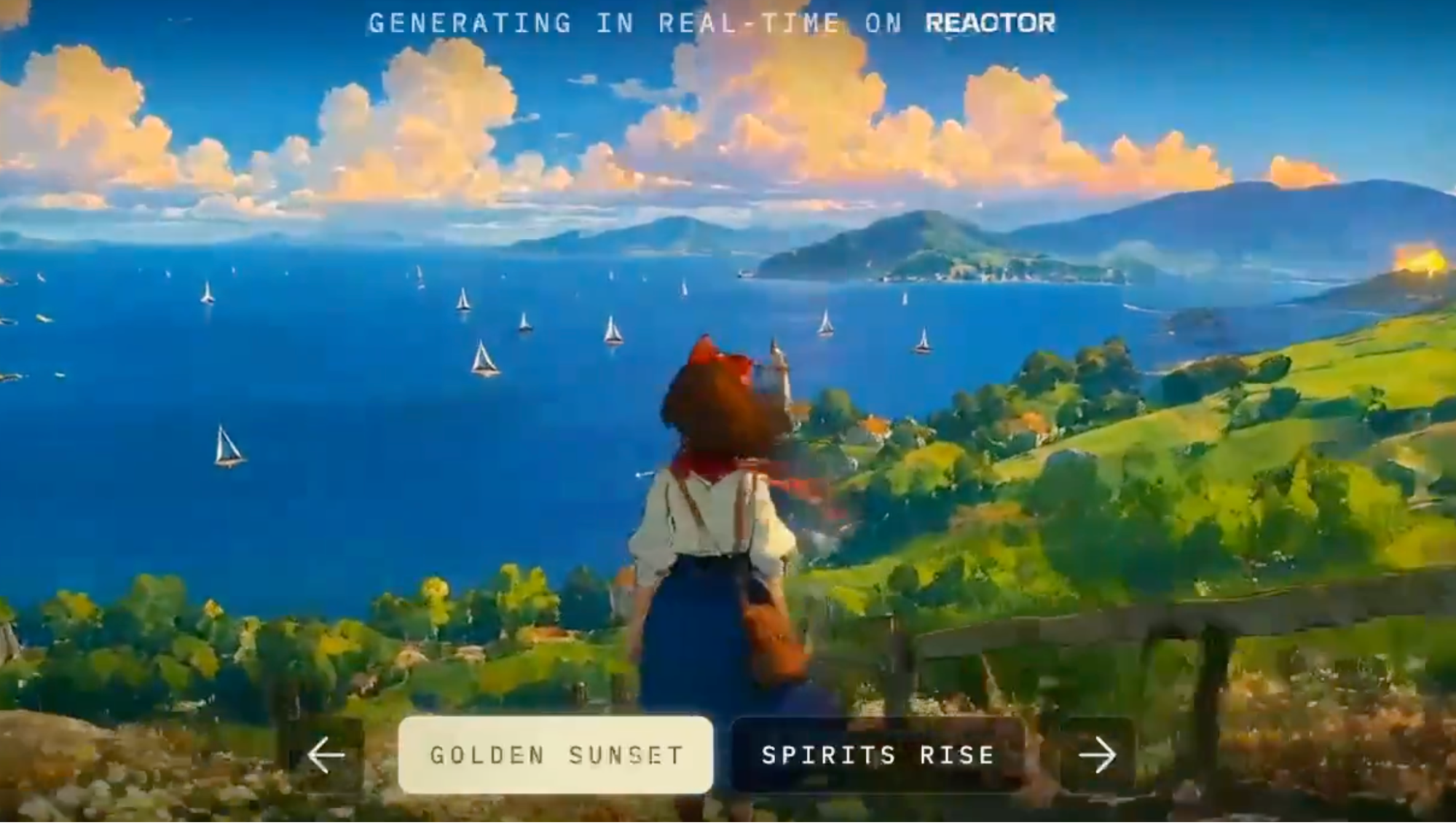
A reference image and a prompt become an interactive video stream. The examples explore how generated scenery can work alongside game rules.
Read article