Marble by World Labs

Describe a place, then step inside—even before you can model it.

Evidence statusPublic-evidence reviewMedium confidenceLast checked Aug 31, 2026By MakeGameWithAI

PRODUCT OVERVIEW

What Marble by World Labs is—and how it works.

Marble is World Labs' online tool for generating and editing 3D worlds. Start with a description, a single image, multiple views, a 360-degree panorama, a video, or a rough 3D layout. The result is an environment you can enter, look around from different positions, save, and revisit—not just a picture viewed from one spot. For a creator without modeling skills, this makes it possible to begin with the place they imagine and judge it by exploring it.

A typical workflow prepares a panorama, optionally edits it or makes a draft, then generates a full world. You can refine the direction, combine spaces, share a browser link, or export visual and geometric data for another tool. This can support a narrative scene or a small game prototype; game rules, interactive objects, and target-device optimization still belong to the next part of the project. A saved, persistent world does not mean a self-simulating world or a finished game.

HOW YOU USE IT

Start in a desktop browser; some advanced tools are unavailable on mobile. Free supports exploration but not exports or commercial use. Check the model, output format, and plan before paying. You do not need to integrate the API to begin; its balance is separate from a Web subscription.

Create a place from words or references

Describe a room or landscape, or guide generation with images, panoramas, or video you have permission to use. Different views help express intent; missing areas can still be invented rather than faithfully reconstructed.

O01O05U02U08

Block out a layout with Chisel

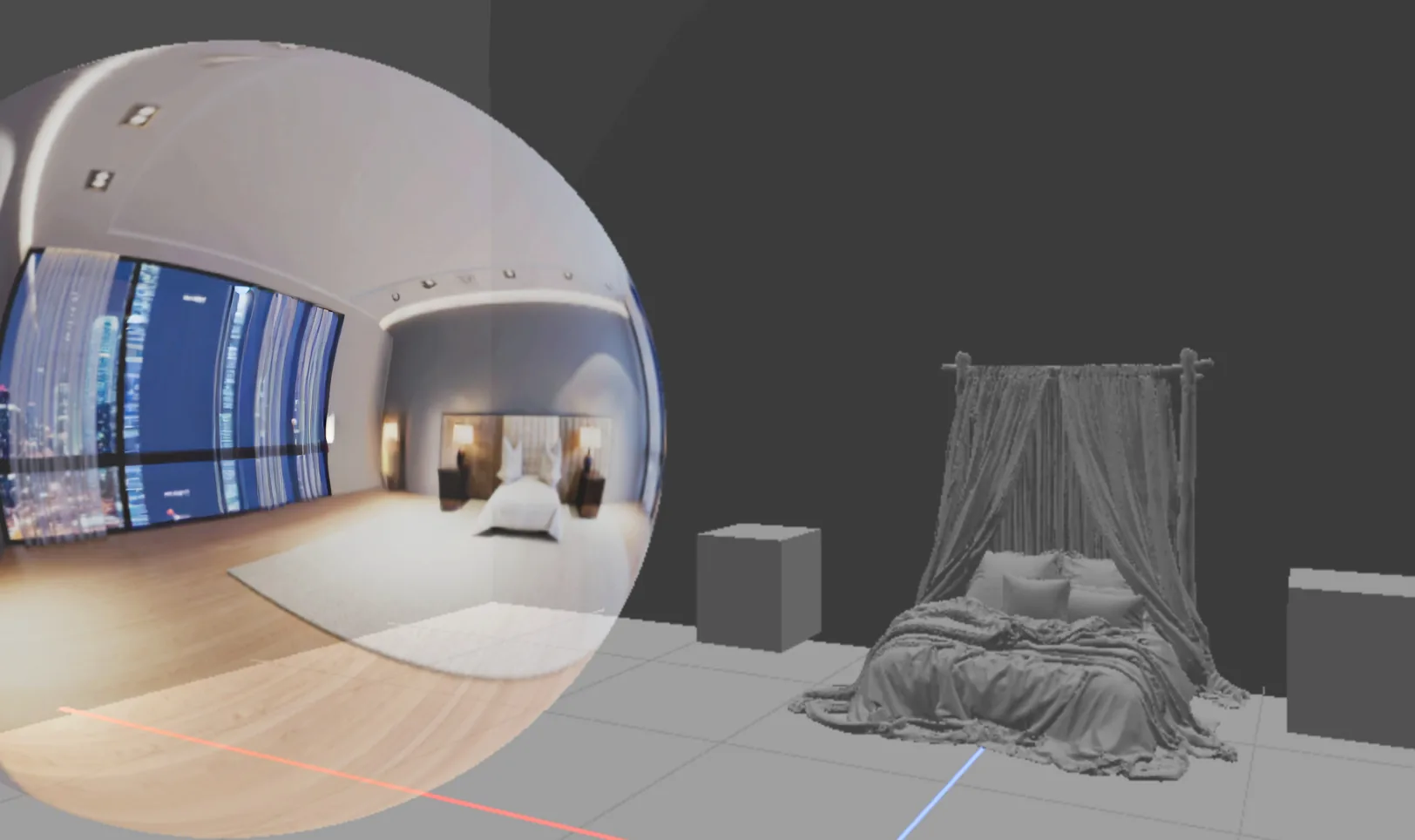
Arrange simple walls and shapes, or import GLB/FBX geometry as guidance. This lets you express a room or passage before detailed modeling, without promising exact dimensions or independently editable furniture.

O06

Edit the reference, then rebuild the world

Pano edit changes the reference image. Its 150-credit charge does not include generating the revised 3D world; budget the subsequent world-generation step separately.

O07O04

Combine spaces and extend compatible worlds

Compose aligns, rotates, scales, and crops worlds together. Expand extends boundaries for 2,000 credits, but currently cannot be used on Marble 1.1 Plus worlds. Doors, floor heights, and transitions still need attention.

O08O21

Export appearance and collision separately

SPZ/PLY splats carry the world's visual appearance and need a compatible renderer. A collider GLB supplies simplified physical geometry; it is not the same thing as the visible scene or a polished art asset.

O09O11O12

Generate a conventional high-quality mesh

The high-quality GLB route is a separate 3,500-credit job, available on Web Pro/Max or through separately billed API access. It supports mesh-based tools, but the result may need substantial cleanup and optimization.

O02O09O14
REVIEW SCOPE

Small pre-generated environments, spatial ideation, and game-prototype handoff. Not a guarantee of faithful scanning, clean modular assets, or a production-ready level on every device.

Beginner friendlinessBeginner friendly
Use text or an image to start an explorable scene without 3D-modeling skills; a playable game level still needs further work.
Agent integrationEasy to integrate
Official World API documentation covers world creation, operation status and asset retrieval for generation workflows.
Scope, integration requirements and sourcesChecked

Beginner scope: Generate and explore one spatial candidate in Marble's web app.

Agent scope: Generate a world candidate and retrieve its world and asset data.

Confidence: learning Medium · Agent Medium

Access
Sign in, create a World API key and configure the API account.
Billing
World API credits are separate from the Marble web subscription.
Getting results
Submit world generation, poll the operation, then retrieve world data and asset links.
Limitations
World files are not a finished game scene; check privacy settings, formats and engine cleanup separately.

These are independent editorial judgments, not an overall score or a claim of hands-on agent integration testing.

KEY FINDINGS

What the evidence supports—and what it does not.

01
Editorial inferenceMedium confidence

Modeling skills help you grow, not qualify to begin

Text, image, and rough-layout inputs let you begin by describing, exploring, and choosing. First-person records show people using those routes to create and revise environments. This supports a practical starting point for non-modelers, while spatial judgment and engine skills improve what you can do next.

O05O06U02U06
02
Editorial inferenceMedium confidence

There are game projects, with other tools doing part of the work

Gaussian Mansion combines Marble environments with Unreal and additional tooling. The Rosebud collaboration adds gameplay around Marble spaces and colliders. These are disclosed vendor/partner cases, not independent votes. Separate author records also show Unity and custom-renderer handoffs, with integration work still visible.

S01S02U02U05
03
Editorial inferenceMedium confidence

A splat, a collider, and a visual mesh are different deliverables

A world looking good in its viewer does not settle how it should enter your game. Historical users describe different results from mesh and splat routes, and renderer-specific performance problems. Choose the representation for the job, then check movement, collision, and the view on your target device.

O09O11O12U01U03
04
Official factHigh confidence

Plus is not a promise that every editing route is available

Marble 1.1 and 1.1 Plus are models, not subscription plans. Plus adds a variable world-generation charge, and its worlds currently cannot use Expand. Panorama editing also precedes a separately billed 3D rebuild. Decide how you intend to revise the environment before selecting the generation route.

O03O04O07O21
05
User reportsMedium confidence

Current-model experience exists, but not a usable-level success rate

Two independent records explicitly cover the 1.1 family: an editor's generation/editing trial and a technical artist's integration project. Most other records concern earlier releases. Hidden-area artifacts, control issues, and crashes are specific reported experiences, not proof that all current worlds succeed or fail in the same way.

U04U05U06U07U08

EDITORIAL VERDICT

Our take

Medium confidence

Marble is worth considering when you want to make a place you can explore before you know how to model it. Its value is an accessible route from an idea to a spatial prototype, with export paths that can connect to a real game project. Start with one small environment and choose whether you need a shareable world, splats plus collision, or a conventional mesh. That choice determines the learning, cleanup, and budget that follow.

Conclusion scopeOwner-approved, medium-confidence public-evidence review. Eight independent records support specific workflows and limitations; two partnership cases illustrate game-building routes. They do not establish current acceptance rates or a fixed cost per usable level.

BETTER FIT

Worth auditioning when

  • Creators who want to start with a description or reference image and explore a space before learning detailed modeling.
  • Narrative scenes, atmosphere studies, and small game prototypes where visual exploration helps develop the idea.
  • Projects willing to use splats plus collision and add gameplay with an engine or another game-building tool.
  • Trying a mesh-based handoff with room in the budget for selecting, cleaning, and optimizing the result.

POORER FIT

Do not depend on it yet when

  • Expecting one prompt to supply a complete game with rules, characters, interactable furniture, and multiplayer behavior.
  • Needing a dimensionally faithful scan, separate low-poly props, or precise architectural reconstruction without revision.
  • Depending on a guaranteed acceptance rate, fixed cost per finished level, or unverified target-device performance.
  • Uploading confidential references or starting a commercial Standard project before resolving the applicable permissions.

WORKFLOW FIT

Where it fits in a production workflow.

01

Turn a scene idea into a place you can explore

Start with one room, courtyard, or small landscape and a clear visual brief. Generate a candidate, walk through the intended viewpoints, and use the result to develop atmosphere, scale, and narrative staging. This can be useful before there is any game code.

GuardrailTreat hidden areas and reference fidelity as things to inspect, not guaranteed reconstruction. Start with material you have permission to upload.
02

Build a small interactive prototype around the environment

Export the visual splat and collider, select a compatible renderer, and add a player controller and one interaction in your game tool. If using Compose, first check transitions and floor alignment. The environment can carry the setting while another tool supplies the rules.

GuardrailBudget third-party plugins and setup separately. Browser-viewer performance does not establish engine performance or correct collision.
03

Choose a candidate before paying for the mesh handoff

Explore candidates first, then generate a high-quality GLB for the direction you want to continue. Bring it into a mesh-based workflow to inspect geometry, materials, scale, and movement paths before doing further art or game work.

GuardrailA paid high-quality export is not a set of clean low-poly props. Allow for simplification, hole repair, and collision checks.

RECOMMENDED WORKFLOW

Use this tool inside a complete production workflow.

Start from a testable brief, then move through prototyping, assets, audio, testing, and release with an explicit handoff and human check at every step.

Open the complete method

SHORTEST RESPONSIBLE PATH

Start with one small place and one intended output

This is a low-risk starting workflow synthesized from the evidence.

  1. 01

    Choose one room or small environment, define the player's viewpoints and movement area, and decide whether the goal is a browser world, splats plus collision, or a conventional mesh.

  2. 02

    Use an authorized reference or a simple description in the desktop Web app. Explore with Free before paying; downloads and commercial permissions require a separate plan decision.

  3. 03

    Inspect the panorama, then generate a world. If you use a 1.0 Draft preview, remember it is a different model route, not a guaranteed preview of a 1.1 result; budget edits and regeneration separately.

  4. 04

    Check the space from intended player positions. Select a candidate before an optional high-quality mesh job; if you need Expand, avoid a 1.1 Plus world under the current restriction.

  5. 05

    For a game handoff, check renderer/plugin terms, scale, collisions, visual artifacts, and target-device performance. Record all paid attempts and the number of environments that actually pass your criteria.

PRICING & RIGHTS

What you pay, which outputs you get, and what remains extra

Pricing and terms last checked: Aug 31, 2026

  • Current Web monthly prices in USD: Free $0 / 7,000 credits; Standard $20 / 20,000; Pro $35 / 40,000; Max $95 / 120,000. These are monthly prices, not annual-equivalent promotions. The Free allowance's refresh schedule is not confirmed.
  • Free: exploration without exports or commercial rights. The current plan table includes multi-image input, Chisel, and advanced editing/expansion access; older help describes narrower permissions. Model-specific restrictions still apply.
  • Standard adds splat/collider downloads but not high-quality mesh exports. Web Pro/Max add high-quality mesh access and list commercial rights, subject to terms. Max buys more quota, not a guaranteed better-quality model. Standard commercial permission remains disputed below.
  • For a fresh text or ordinary single-image route: input preparation costs 80 credits, then Marble 1.1 costs 1,500. Multiple-image/video preparation costs 100. Marble 1.1 Plus costs 1,500 plus 0–1,500 for world generation; 1.0 Draft uses a different 150-credit world step.
  • Additional operations: panorama edit 150 credits, Expand 2,000, high-quality mesh 3,500. A panorama edit alone does not rebuild the world. Current Expand excludes worlds generated with 1.1 Plus.
  • Web subscription quota does not roll over. Paid Web top-ups currently offer $5 / 5,000 credits, $20 / 22,000, or $50 / 63,000; top-ups roll over but expire after one year. Their rates are not the Pro quota-allocation rate used below.
  • API uses a separate balance: $1 buys 1,250 credits, minimum purchase $5, with no expiry. Web quota and API credits cannot be transferred. An already completed or running identical high-quality mesh export is reused without another export charge; the documented mesh job includes textured and vertex-colored variants.
COST TO OUTPUT

From monthly payment to candidate-output budgets

Web examples allocate the Pro monthly payment across its full quota: $35 ÷ 40,000 = $0.000875 per credit. The actual monthly payment is still $35, even for one use. Each example is an alternative budget, not an extra allowance; counts assume the entire quota is used only for that workflow. These are calculations, not observed bills or accepted-game-asset prices.

O02O03O04O07O09O14O19O21
One ordinary 1.1 world candidate1,580 credits → about $1.38

80 for text/single-image preparation + 1,500 for a 1.1 world = $1.3825 nominal allocation. The quota fits 25 candidates with 500 credits left. This does not include a high-quality mesh job or say how many candidates you will keep.

One 1.1 Plus world candidate1,580–3,080 credits → $1.38–$2.70

The same 80-credit preparation plus 1,500 and a variable 0–1,500 world charge. All-quota capacity is 12–25 candidates depending on actual charges; no high-quality mesh is included. Plus worlds currently cannot use Expand.

One 1.1 world plus a high-quality mesh5,080 credits → about $4.45

80 + 1,500 + 3,500 = 5,080 credits, or $4.445 nominal allocation. Pro fits 7 complete workflows with 4,440 credits left. Seven workflows are not seven usable levels, and $4.45 is not a pay-per-asset checkout price.

Compare three directions, mesh only the chosen one8,240 credits → $7.21

3 × 1,580 + 3,500 = 8,240 credits. Pro fits 4 such rounds with 7,040 credits left. Three candidates per round is an illustrative planning choice, not an observed retry average or a promise that one will pass.

The comparable API route uses a different balance5,080 ÷ 1,250 → about $4.06

The 1.1 candidate consumes $1.264 and the mesh $2.80, totaling $4.064. Minimum prepayment is $5, nominally leaving 1,170 credits after this workflow. Integration work is extra. The $5 purchase is not a hard spending cap; negative balances can be billed later.

A usable environment has an unknown real costIf only one passes: $35 + extras

If one environment passes and you allocate the entire month's subscription to it, its cash allocation is $35 before top-ups, plugins, and labor. With no accepted environment, there is no finite cost per accepted output. We have not measured the acceptance rate or cleanup time.

Taxes, additional edits/expansions, rejected candidates, plugins, engine setup, and cleanup are outside these nominal examples. Reuse, top-ups, model choice, and unused quota change the economics. A 1.0 Draft is a different preview route: 80 + 150 = 230 credits, not a cheaper equivalent of a full 1.1 world.

Commercial-use condition

Standard commercial rights remain unresolved: the current pricing table excludes them, while Terms sections 3.3 and 13.23 describe paid commercial use and include Standard as Paid. Get applicable written confirmation before relying on Standard for a commercial project. Pro/Max list commercial rights subject to terms and input/third-party rights. Free-generated outputs do not gain commercial rights merely because you later upgrade; applicable disclosure and attribution conditions still matter.

Subscriptions renew automatically; cancellation takes effect at the end of the paid period without a prorated refund. No universal failed-task refund promise was established. Historical $1 Pro promotions have ended. Confirm the displayed model charge and applicable terms before paying, and keep API spend monitoring separate from the auto-refill setting.

PRODUCTION RISKS

Resolve these before production use.

Mesh density and integration can become the real work

The documented high-quality meshes are roughly 600k triangles with textures or 1M with vertex colors, not automatically optimized low-poly assets. Holes, floating geometry, thin surfaces, reflections, and transparency can need attention. Raw API SPZ coordinates also differ from some Web handoff assumptions; follow the relevant export metadata, not a blanket axis flip.

O09O11O12O13U03U05

Private visibility is not the same as training opt-out or deletion

Paid users have a prospective training opt-out under the terms; it does not undo prior training. Visibility settings are a separate control, and a universal deletion deadline was not established. Check the current account controls and input rights before uploading unreleased art, private interiors, or other sensitive references.

O16O17O18

An API prepaid balance is not a hard project budget

API job admission checks a low-balance threshold rather than reserving every job's full predicted cost. Usage can make the balance negative and lead to later billing even with auto-refill disabled. Apply your own job limits and usage checks before automating generation.

O14

NOT VERIFIED

Claims this page does not make

RESEARCH METHOD

Research-reviewed from public evidence

8 independent author records across 6 platforms: note.com, GitHub, Hacker News, an individual project site, Sina's Jiqizhixin article, and Reddit. Four evidence formats cover hands-on/project write-ups, an issue, first-person discussions, and an editorial trial. note.com contributes 3 of 8 (37.5%); Reddit contributes 1 of 8 (12.5%). Only two explicitly cover 1.1; earlier experiences are labeled historical. Vendor/partner cases S01–S02 are grouped with official material and excluded from the independent count. Targeted searches also covered GameDev.net and other engine/art communities without finding a qualifying record; search snippets, inaccessible bodies, reposts, and agreement-only replies were not counted. This sample supports specific claims, not population-level success rates. Workflow suggestions are editorial synthesis of the documented routes and cited experiences.

Research windowResearch and pre-page pricing, model, export, and terms checks: August 31, 2026. Prioritizes August 31, 2025 onward; seven records fall in that window and one project is undated. Only two records explicitly cover the 1.1 family.
OFFICIAL SOURCES20
  1. O01
    Official
    Marble documentation and product overview

    Inputs, saved worlds, and creation entry points. Vendor capability descriptions are not measurements of game readiness.

    Checked Aug 31, 2026
  2. O02
    Official
    Marble Web plans and pricing

    Current monthly prices, quotas, top-ups, and feature permissions, checked against the public pricing-page configuration. Standard commercial rights conflict with the linked terms; no account-specific checkout was completed.

    Checked Aug 31, 2026
  3. O03
    Official
    Marble models and generation credits

    Marble 1.1, 1.1 Plus, and the older 1.0/Draft routes. Model names, subscription tiers, and generation charges are separate concepts.

    Checked Aug 31, 2026
  4. O04
    Official
    Account, credits, and billing

    Input preparation, world generation, mesh charges, quota expiry, and billing rules. Older feature-permission descriptions do not override the current plan table.

    Checked Aug 31, 2026
  5. O05
    Official
    Creating and editing worlds

    Preparing a panorama, optional drafts, and full world generation. This is a documented workflow, not an account-level test by this site.

    Checked Aug 31, 2026
  6. O06
    Official
    Chisel: rough 3D layouts

    Blocking out space and importing GLB/FBX guidance. Layout control is not a guarantee of exact dimensions or separate reusable props.

    Checked Aug 31, 2026
  7. O07
    Official
    Panorama editing

    Edits the panorama reference; generating the revised 3D world is a subsequent step with its own charge.

    Checked Aug 31, 2026
  8. O08
    Official
    Compose: combine generated worlds

    Manual alignment, scale, rotation, and overlap handling. Combining worlds does not automatically solve doors, floor heights, or game navigation.

    Checked Aug 31, 2026
  9. O09
    Official
    Collider and high-quality mesh exports

    Distinguishes visual splats, simplified collision geometry, and separately generated high-quality GLB meshes, including substantial mesh density and known artifacts.

    Checked Aug 31, 2026
  10. O11
    Official
    Gaussian splats in Unity

    Export and renderer routes, including third-party tools. A listed integration is not a tested compatibility or performance guarantee.

    Checked Aug 31, 2026
  11. O12
    Official
    Gaussian splats in Unreal Engine

    Downstream Unreal workflows and third-party renderer dependencies. Plugin pricing and engine-version constraints require separate checks.

    Checked Aug 31, 2026
  12. O13
    Official
    Rendering API SPZ files

    Raw API export coordinates and rendering metadata. Do not apply an API-specific axis correction indiscriminately to Web exports.

    Checked Aug 31, 2026
  13. O14
    Official
    World Labs API pricing and balances

    Separate prepaid balance, 1,250 credits per dollar, generation/export rates, and negative-balance billing. Disabling auto-refill is not a hard spending cap.

    Checked Aug 31, 2026
  14. O16
    Official
    World Labs Terms of Service

    Paid/free output rights, renewal, and training controls. Sections 3.3 and 13.23 conflict with the current pricing table on Standard commercial permissions.

    Checked Aug 31, 2026
  15. O17
    Official
    World Labs Privacy Policy

    Data handling and retention conditions. Private visibility, a prospective training opt-out, and deletion are different controls.

    Checked Aug 31, 2026
  16. O18
    Official
    World Labs Acceptable Use Policy

    Use restrictions and disclosure requirements. Paid access does not remove responsibility for input rights or applicable attribution conditions.

    Checked Aug 31, 2026
  17. O19
    Official
    Marble release notes

    Model and feature changes, and historical promotions. The December 2025 $1 Pro offer is not today's subscription price.

    Checked Aug 31, 2026
  18. O21
    Official
    Expand: extend a world

    Extends the boundary for 2,000 credits. The current help excludes worlds generated with Marble 1.1 Plus.

    Checked Aug 31, 2026
  19. S01
    Official
    World Labs case study: Gaussian Mansion

    Vendor-selected game case by José Tijerín using Marble, Unreal, and additional tools. The game listing was checked, not downloaded or played; this is not an independent sample.

    Checked Aug 31, 2026
  20. S02
    Official
    Rosebud × World Labs: building a game with Marble

    Explicit partnership/marketing workflow: Marble provides environments and colliders, Rosebud adds gameplay. This does not establish a released native integration or independent endorsement.

    Checked Aug 31, 2026
INDEPENDENT EVIDENCE RECORDS8
  1. U01
    Community case
    Kongo Jun: comparing mesh and splat handoff

    First-person early-Pro attempt: a mesh in Blender was less convincing than the SPZ in Spark 0.1.10. Historical workflow evidence, not a current price, timing, or quality comparison; sponsorship is not declared.

    Checked Aug 31, 2026
  2. U02
    Community case
    Kayac Bond: room generation and Unity import

    An engineer describes invented/blurred hidden areas, improvements with multiple references, and a PLY import using UnityGaussianSplatting. Engine version is unstated; company technical blog, vendor funding undeclared.

    Checked Aug 31, 2026
  3. U03
    Technical repository
    Spark issue #202: Marble export performance

    Beta-era author report on an M4 MacBook Air: their Marble export ran less smoothly in Spark than the hosted viewer. Configuration is incomplete and the issue remains open; not a current benchmark or universal fault.

    Checked Aug 31, 2026
  4. U04
    Community case
    Hacker News: first-person early-world artifacts

    Thetoon describes artifacts after leaving familiar areas in a few generated worlds. The specific comment was verified; its guesses about the underlying algorithm are excluded. Plan and sponsorship are unstated.

    Checked Aug 31, 2026
  5. U05
    Community case
    Chris Rogers: Utariga procedural-city integration

    Undated project explicitly comparing 1.1 with 1.0 and documenting panorama/depth, scale, axis, and renderer work. Procedural buildings and external segmentation are separate systems, not native Marble features; self-promotional portfolio, funding undeclared.

    Checked Aug 31, 2026
  6. U06
    Community case
    Jiqizhixin: a first-person Marble 1.1 and Plus trial

    Editors describe their own Pro generation and panorama-editing attempts. Only those attempts count, not embedded social reposts; no engine export or acceptance-rate evidence. Sponsorship is not declared.

    Checked Aug 31, 2026
  7. U07
    Community case
    Reddit: an early Pro conference-room attempt

    November 2025 comment by whichanna23 describing crashes, resolution disappointment, and waits, including an edited account. No final resolution or refund is documented; one author's event, not the thread's votes or agreement.

    Checked Aug 31, 2026
  8. U08
    Community case
    Tetta Takamura / MESON: reconstructing an office

    Compares office video, four views, and a panorama, with Compose/Expand/Chisel limitations. One early case, not today's input ranking. The author works for a company selling 3D capture, a relevant commercial interest.

    Checked Aug 31, 2026

DISCLOSURE

How this research was supported

Owner Review passed on August 31, 2026, accepting this bounded public-evidence review. This research introduced no sponsorship, gifted credits, or affiliate arrangement, and involved no generation purchases or engine tests. The owner's prior product experience and commercial relationships remain unstated; approval does not resolve the documented licensing conflict.

Research review and Owner Review are complete.

This public research review will be revisited when pricing, terms, product versions, or material new evidence changes.