Tripo

A fast path from an idea or reference image to a first 3D asset—provided you budget for selection, cleanup, and engine acceptance.

Evidence statusPublic-evidence reviewMedium confidenceLast checked Aug 24, 2026By MakeGameWithAI

PRODUCT OVERVIEW

What Tripo is—and how it works.

Tripo is a cloud 3D-asset platform for people who want to turn text, a single image, or several views into a downloadable model without first building that model by hand. Tripo Studio packages generation with texturing, segmentation, mesh optimization, rigging, animation, and export; Tripo API exposes many of the same tasks for automation, while listed bridges connect the workflow to Blender, Unity, Unreal Engine, Godot, and other DCC or engine environments.

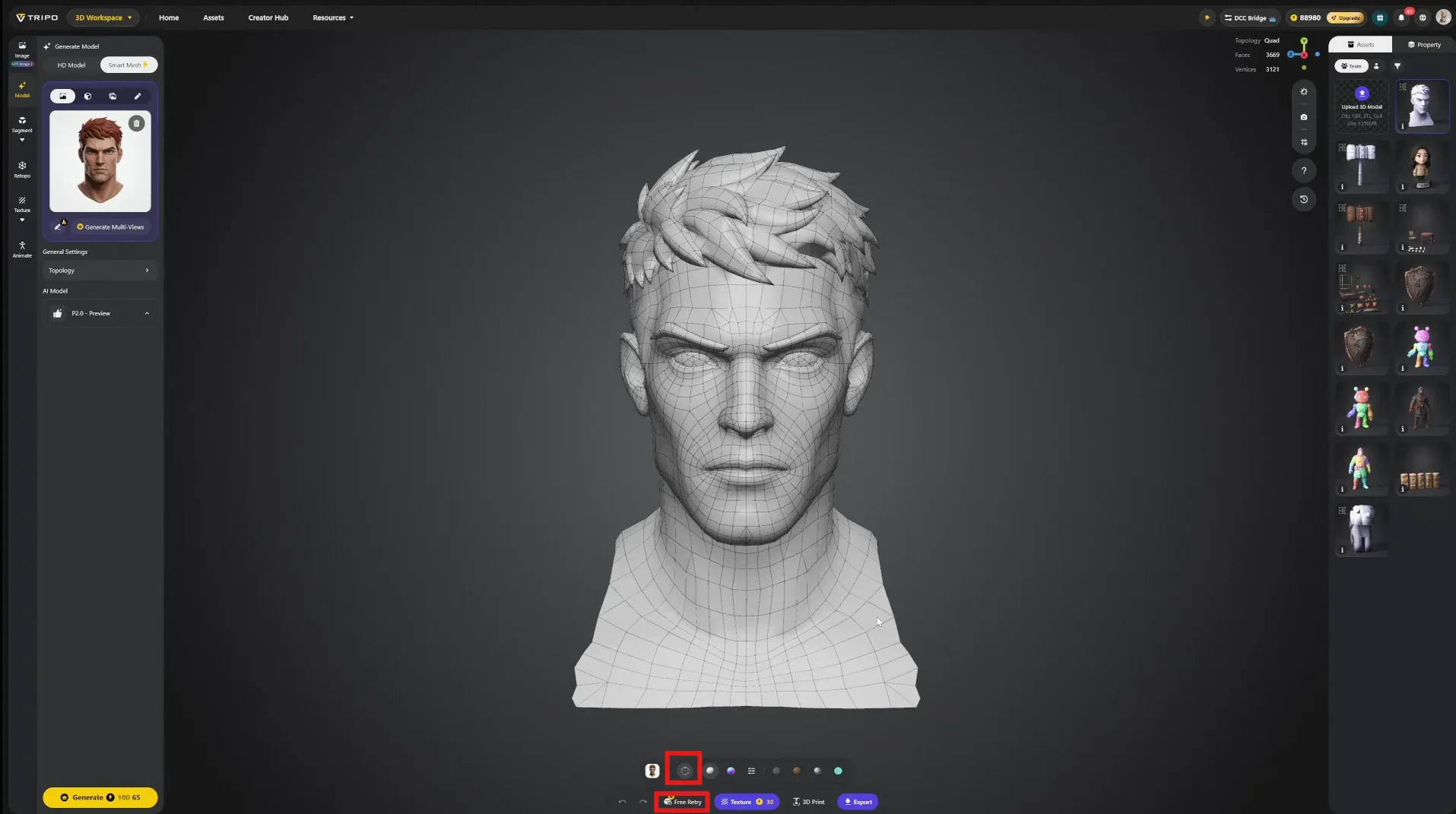
The current product is not one undifferentiated model. H3.1 is positioned for high-detail output; Smart Mesh P1 provides structured low-poly generation and face-count controls; P2.0 Preview adds native quad output but was only five days old at the research cutoff. Text is useful for exploration, while image and multiview input give a clearer reference when a prop or character needs to resemble an existing design.

A responsible game workflow is: generate several candidates, choose the model path that matches the asset, inspect the hidden sides and part structure, complete mesh and material edits, then rig only after mesh-changing operations are finished. Exporting GLB or FBX is a handoff point—not proof of completion. Blender or another DCC and the target engine still need to check scale, pivot, collisions, materials, UVs, LODs, deformation, naming, and the target performance budget.

HOW YOU USE IT

Tripo Studio has Free, Pro, Max, and Team plan surfaces; commercial and private use begins on paid plan labels. The API uses a separate credit wallet, so Studio credits do not fund API work. Feature access, concurrency, history, storage, export, retries, beta access, and bridges vary by plan.

Text, image, and multiview generation

Studio and API routes cover exploratory text prompts, single-reference generation, and four-direction multiview input. P1 and H3 serve different geometry goals, while P2 remains a separate Preview track.

O01O02O03O04O05

Mesh, texture, and part refinement

Face-count controls, PBR texturing, segmentation, conversion, and Smart Mesh can shorten preparation, but editable UVs, topology flow, exact parts, LODs, and project-specific cleanup remain acceptance questions.

O01O03O05O06U03U05

Rigging and animation after mesh edits

Rig v2.5 and retarget actions create a route for prototype characters. Tripo's own task rules make the order important: remesh, segmentation, or completion after rigging will discard the existing skeleton or animation.

O06O07O08

Studio, API, export, and bridge surfaces

Creators can work interactively, call metered API tasks, export common 3D formats, or use listed DCC and engine bridges. Each bridge has its own version, material, editor, path, or compilation constraints.

O09O10O11O12O13U11
REVIEW SCOPE

This review covers Tripo as an entry point for static props, environment clutter, placeholders, visual exploration, and conditional prototype characters in small game workflows. It does not rank 3D generators, test current output quality, validate P2.0 Preview, or claim that exports are production-ready across engines and target devices.

Beginner friendlinessBeginner friendly
Generate and preview models from text or images in the browser without modeling skills, then select and clean up candidates.
Agent integrationEasy to integrate
The official REST API documents authentication, generation and task results for agent-driven downloads.
Scope, integration requirements and sourcesChecked

Beginner scope: One 3D prototype asset in Tripo Studio.

Agent scope: Generate one model, check status and retrieve its output.

Confidence: learning Medium · Agent Medium

Access
Enable API access and configure a Tripo API key.
Billing
Budget against the API account; do not assume Studio and API balances are interchangeable.
Getting results
Submit for a task_id, poll for success or failure, then obtain model links.
Limitations
Keep task IDs, handle failures and save files; generation does not guarantee production readiness.

These are independent editorial judgments, not an overall score or a claim of hands-on agent integration testing.

KEY FINDINGS

What the evidence supports—and what it does not.

01
Official factHigh confidence

The product spans far more than initial generation

Official Studio and API material covers text, image, and multiview generation; texturing, segmentation, mesh work, rigging, animation, conversion, export, and several DCC or engine routes. This establishes that the workflow surfaces exist, not that every step is equally mature or automatic.

O01O02O03O04O07O08O10O11O12
02
User reportsMedium confidence

You can begin making 3D assets before you can model

A first-time 3D user reached game-Jam models, a validated reviewer described skipping early blockout, and launch-community comments repeatedly describe approachable iteration. These records do not prove release readiness, but they support a real reduction in the entry barrier.

U02U07U12
03
Editorial inferenceMedium confidence

Static props are the strongest current use case

Across a scenery developer, professional cleanup discussion, a negative counterexample, and a solo game pipeline, non-deforming props and scene clutter recur as the safer value. Character quality, topology, UVs, rigging, and deformation create more ways for time savings to disappear.

U01U05U08U10O06
04
User reportsMedium confidence

Reference images improve control but do not reveal hidden truth

Tripo's multiview route explicitly asks for directional views, and the scenery case reports better results from photos or multiple angles. Hidden surfaces, occluded parts, exact dimensions, and part separation still need inspection; no input method guarantees faithful reconstruction.

O04U01
05
User reportsMedium confidence

Generation, export, engine import, and release are four different states

Independent workflows and even the vendor's city case retain Blender or Maya cleanup, topology work, materials, LODs, conversion, integration, and in-game testing. A bridge reduces transfer friction, but it does not own asset acceptance.

O10O11O12O17U01U03U05U06U10
06
Editorial inferenceHigh confidence

Triangles are not an automatic failure; topology purpose still matters

P1 currently produces triangle meshes and P2 Preview adds native quads. Runtime GPUs render triangles, so triangle-versus-quad alone does not determine performance. Editability, edge flow, deformation, reduction, LODs, and the measured target budget determine whether a mesh is suitable.

O03O05U04
07
Editorial inferenceHigh confidence

A cheap API call is not a cheap accepted asset

At current rates, a representative textured image-to-model candidate plus conversion is nominally $0.55; adding rigging and one retargeted action makes the example $0.90. Retries, technically successful but rejected geometry, DCC labor, and engine acceptance determine the real unit cost.

O13O14U01U05U08
08
Official factHigh confidence

Commercial rights and data handling require plan-specific reading

The pricing page labels Free output public and non-commercial, while paid plans allow private and commercial use. Paid-user rights do not create exclusivity or a non-infringement guarantee. The API FAQ's unresolved XXX retention placeholder keeps sensitive-upload policy uncertain.

O09O14O15O16

EDITORIAL VERDICT

Our take

Medium confidence

Tripo materially lowers the starting barrier for people who cannot model in 3D. It can move an idea or reference image to a visible, downloadable, and sometimes immediately prototype-usable asset in minutes, which is a meaningful change for individual game makers who previously had no practical route to make their own 3D content. The strongest evidence is for static props, clutter, backgrounds, placeholders, and form exploration. Characters and exact hard-surface or multi-part assets remain conditional because topology, UVs, parts, rigging, deformation, and performance can turn generation speed into cleanup cost. Treat Tripo as a base-asset and prototype accelerator, learn the minimum DCC and engine acceptance loop, and measure the models you finally keep—not only the models the service successfully generates.

Conclusion scopeMedium-confidence, research-reviewed guidance for small game workflows. It is not a controlled quality test, a success-rate estimate, a comparison against Meshy or other generators, or a promise that one-click output is ready for release.

BETTER FIT

Worth auditioning when

  • People without traditional 3D-modeling skills who need a first prop, character base, or visible prototype rather than another abstract concept document.
  • Static props, environment clutter, background objects, placeholders, and form exploration where small geometric differences are acceptable.
  • Image- or multiview-led tasks with clear references and a willingness to inspect hidden sides, parts, materials, scale, and engine import.
  • Individual game makers and small teams that can keep a simple Blender-or-equivalent cleanup step and measure candidate, retry, cleanup, and accepted-asset cost.

POORER FIT

Do not depend on it yet when

  • Hero characters, faces, cloth, hair, exact mechanical assemblies, modular architecture, or deformation-critical assets when manual retopology and art review are unavailable.
  • Large batches with strict mobile, console, WebGL, or other runtime budgets when nobody owns profiling, LOD, collision, material, and import acceptance.
  • Sensitive, unreleased, NDA-bound, or client assets when the current retention ambiguity and account terms are unacceptable.
  • Pipelines that equate a successful generation or export with a production-ready, legally cleared, exclusive, or performance-approved asset.

WORKFLOW FIT

Where it fits in a production workflow.

01

First static prop

Start from a clean reference image or a narrow text brief, generate several candidates, select one by silhouette and hidden-side inspection, then correct scale, pivot, materials, UVs, mesh issues, collisions, LODs, and naming before engine acceptance.

GuardrailUse one non-deforming prop to establish your cleanup and acceptance checklist before buying around a large asset count.
02

Prototype character

Choose the geometry path, finish remesh, segmentation, completion, materials, and part edits, then rig and test a small motion set. Inspect weights, joints, silhouette, feet, hands, face, cloth, and engine-scale behavior.

GuardrailDo not rig before mesh-changing operations are complete, and do not extrapolate one biped success to faces, cloth, unusual proportions, or complex creatures.
03

API or batch pipeline

Keep Studio and API budgets separate, log task type, credits, version, input, technical success, rejection reason, cleanup minutes, and engine result. Promote only assets that pass a defined acceptance gate.

GuardrailConcurrency and a low per-call price increase throughput, not quality assurance. Add spend caps, retries, provenance, backups, and human review before scale.

RECOMMENDED WORKFLOW

Use this tool inside a complete production workflow.

Start from a testable brief, then move through prototyping, assets, audio, testing, and release with an explicit handoff and human check at every step.

Open the complete method

SHORTEST RESPONSIBLE PATH

Prove one static prop before planning a generated asset library

This is a low-risk starting workflow synthesized from the evidence.

  1. 01

    Choose one ordinary, non-deforming prop whose silhouette and target triangle budget you can judge.

  2. 02

    Prepare a clean reference image; add directional views when shape accuracy matters more than exploration.

  3. 03

    Generate a small candidate set and record the model path, credits, retries, and reasons for rejection.

  4. 04

    Open the selected asset in Blender or an equivalent DCC; inspect hidden sides, parts, topology, UVs, materials, scale, pivot, and naming.

  5. 05

    Import it into the real engine scene; add collisions and LODs, then profile the target device and visual conditions.

  6. 06

    Accept or reject it, record total human minutes and paid credits, and only then decide whether characters, API automation, or a larger plan is justified.

PRICING & RIGHTS

Generation is inexpensive; accepted-asset cost includes every rejected candidate and cleanup hour.

Pricing and terms last checked: Aug 24, 2026

  • Studio currently shows Free at $0 with 200 monthly credits and about 13 estimated models; annual-billing display shows Pro at $19.90/month with 3,000 credits and about 200 models, and Max at $89.90/month with 25,000 credits and about 1,660 models. These are vendor estimates, not complete asset-workflow counts.
  • The displayed plan price divided by the displayed estimated model count does not match the page's separate per-model labels. This review retains the visible plan, credit, and estimated-output numbers but does not treat the label as a verified production-unit price.
  • The API currently uses $1 = 100 credits. P1 text-to-textured-model is 40 credits; P1 image or multiview-to-textured-model is 50; basic conversion is 5; rigging is 25; and one retargeted action is 10.
  • New API accounts receive 300 credits valid for two weeks. Purchased API credits do not expire; failed tasks are not charged or are later refunded. Studio and API credits are independent and cannot be shared.
COST TO OUTPUT

What one dollar buys before cleanup and acceptance

Transparent API arithmetic at $1 = 100 credits. A candidate is a technically successful output, not a production-ready or finally accepted game asset.

O13O14U01U05U08
Textured image candidate50 credits → $0.50

One P1 image- or multiview-to-model task with texture. No conversion, rigging, animation, retry, cleanup, or engine work is included.

Static candidate chain55 credits → $0.55

Image-to-textured-model plus one basic conversion. The 300-credit trial can fund at most five such candidates; a $10 API budget can fund 18 before cleanup.

Animated candidate chain90 credits → $0.90

Image-to-textured-model, rigging, one retargeted action, and conversion. The free trial can fund three; $10 can fund 11 before weight, deformation, and engine acceptance.

Actual accepted-asset cost = (all paid credits + candidate-selection time + DCC correction time + engine acceptance time) ÷ assets finally accepted. A geometrically unusable result may still be a technically successful paid task, and no defensible current first-pass acceptance rate is public.

Commercial-use condition

The checked Studio pricing page labels Free output public and non-commercial, while Pro and Max include private and commercial use. The Terms generally give paid users broad rights in their inputs and outputs, subject to lawful inputs and a service-use license, but Tripo does not guarantee output exclusivity, non-infringement, accuracy, fitness, or copyright status. Confirm the active plan and controlling terms for a commercial release; this is not legal advice.

Prices, promotions, credits, estimated model counts, model versions, previews, bridges, terms, and privacy language can change. Subscriptions auto-renew and fees are generally non-refundable under the checked Terms; recent complaints make it prudent to verify cancellation in the account, save the confirmation, and monitor the next statement. Do not upload sensitive material until the API retention placeholder and the applicable account policy are acceptable.

PRODUCTION RISKS

Resolve these before production use.

Topology, UVs, parts, and runtime budget

A plausible render can hide fragmented UVs, non-manifold geometry, poor edge flow, fused or missing parts, excessive materials, or a triangle distribution that does not fit the target. Inspect and profile the actual asset.

O03O05U01U03U04U05

Characters multiply acceptance work

Rigging availability does not prove usable weights, joints, facial structure, cloth, hair, or animation. Finish mesh-changing operations first, then test deformation in the actual engine and prepare for manual repair.

O06O07O08U05U08

Low nominal cost can hide rejected work

Credit arithmetic counts successful service tasks. It does not count unusable geometry, repeated prompts, extra texture or mesh operations, DCC minutes, engine integration, or the opportunity cost of reviewing a large candidate set.

O09O13O14U01U05U08

Rights, visibility, and retention are different questions

Commercial permission does not create exclusivity, non-infringement, confidentiality, or immediate deletion. Free and paid rights differ, Studio and API language differ, and the current API retention placeholder remains unresolved.

O09O14O15O16

Plans, cancellations, and bridges need operational checks

Auto-renewal, generally non-refundable fees, separate credit wallets, bridge versions, material pipelines, editor modes, paths, and compilation builds can all interrupt a seemingly simple purchase or handoff. Record the exact environment and keep recoverable exports.

O09O10O11O12O14O15U09U11

NOT VERIFIED

Claims this page does not make

RESEARCH METHOD

Research-reviewed from public evidence

Research-reviewed from public evidence. We checked 17 official product, API, pricing, terms, privacy, and integration sources and coded 12 independent records. Fourteen platforms or site groups were searched and 11 produced usable evidence. The records span seven practical environments: professional DCC and 3D communities, game-development and engine communities, a working scenery developer, a vendor-run Game Jam, review platforms, a broad AI-game community, and a technical repository. Trustpilot contributes the largest single-platform share at two of 12 records (16.7%); Reddit contributes one. Vendor material is not counted as user evidence, vendor-run or referral-linked records are labeled and down-weighted, and positive and negative counterexamples are retained. Confidence is medium: entry-level and cleanup themes recur across environments, while current quality, acceptance rate, P2 Preview, and accepted-asset cost remain unmeasured.

Research windowCurrent official product, API, pricing, terms, privacy, and integration material checked through Aug 24, 2026; independent records emphasize 2026 workflows. Tripo P2.0 had been in Preview for only five days and is excluded from stable-quality conclusions.
OFFICIAL SOURCES17
  1. O01
    Official
    Tripo for game developers

    Official game-development scope covering text and image generation, Smart Mesh, PBR texturing, rigging, animation, export, and engine or DCC workflows. Production-ready language is treated as a vendor claim.

    Checked Aug 24, 2026
  2. O02
    Official
    OpenAPI changelog

    Current API model and feature timeline, including H3.1, P1-20260311, Rig v2.5, and the multiview generation and editing chain.

    Checked Aug 24, 2026
  3. O03
    Official
    P1 text-to-model API

    P1 controls for structured low-poly generation, face count, texturing, PBR, real-world scale, and UV-related options.

    Checked Aug 24, 2026
  4. O04
    Official
    P1 multiview-to-model API

    Front, left, back, and right image slots, minimum-view requirements, and the appearance-versus-geometry consistency tradeoff.

    Checked Aug 24, 2026
  5. O05
    Official
    Tripo P2.0 Preview

    Preview announcement for native quad output and expanded face-count controls. The vendor also says mesh stability and control remain work for the formal release.

    Checked Aug 24, 2026
  6. O06
    Official
    Smart Mesh tutorial

    Vendor workflow for P1 low-poly use, with an explicit recommendation to use a high-detail model plus manual retopology for final animated characters.

    Checked Aug 24, 2026
  7. O07
    Official
    Rig v2.5 API

    Supported formats and rig specifications, plus the warning that remesh, segmentation, or completion does not preserve an existing skeleton or animation.

    Checked Aug 24, 2026
  8. O08
    Official
    Animation retarget API

    Preset retarget actions for several body plans and the current per-request action limit.

    Checked Aug 24, 2026
  9. O09
    Official
    Tripo Studio pricing

    Live Free, Pro, Max, and Team plan display, monthly credits, estimated model counts, plan-specific commercial-use labels, concurrency, storage, export, and listed bridge availability.

    Checked Aug 24, 2026
  10. O10
    Official
    Tripo DCC Bridge for Blender

    Official Blender bridge workflow and its setup, browser, version, and operating constraints.

    Checked Aug 24, 2026
  11. O11
    Official
    Tripo DCC Bridge for Unity

    Official Unity bridge workflow and limitations around editor mode, material pipelines, paths, and supported versions.

    Checked Aug 24, 2026
  12. O12
    Official
    Tripo DCC Bridge for Unreal Engine

    Official Unreal Engine bridge workflow and version, compilation, path, and editor constraints.

    Checked Aug 24, 2026
  13. O13
    Official
    Tripo API pricing

    Current $1-to-100-credit exchange and task prices used for the transparent static and animated candidate calculations.

    Checked Aug 24, 2026
  14. O14
    Official
    Tripo API support FAQ

    Free API credits, failed-task charging, separate Studio and API wallets, training statement, and an unresolved XXX placeholder for input and output retention.

    Checked Aug 24, 2026
  15. O15
    Official
    Terms of User Agreement

    Input responsibility, Free versus paid-user rights, non-exclusivity and non-infringement disclaimers, training language, renewal, refund, storage, and visibility terms.

    Checked Aug 24, 2026
  16. O16
    Official
    Privacy Policy

    Studio data collection, generated-content metadata, service operation and improvement purposes, and possible sharing categories.

    Checked Aug 24, 2026
  17. O17
    Official
    How Many People Does It Take to Build a City? One.

    Vendor collaboration case whose own pipeline still includes Blender cleanup, low-poly optimization, game-format conversion, server integration, and in-game testing.

    Checked Aug 24, 2026
INDEPENDENT EVIDENCE RECORDS12
  1. U01
    Community case
    AI 3D model creation tools, specifically Tripo Studio

    A scenery developer's paired 2026 threads on vehicles and small scene objects, photo and multiview inputs, Blender material and mesh work, LODs, P1, and an early P2 Preview result. The author includes a referral link, so the record is down-weighted.

    Checked Aug 24, 2026
  2. U02
    Community case
    Using of 3D AI models

    A first-time 3D user's Unity Jam question: Tripo enabled initial characters and interactables, while a generated wall and floor scene exposed performance-budget and scene-construction gaps. The Jam was vendor-run.

    Checked Aug 24, 2026
  3. U03
    Community case
    Retexturing AI assets

    A multi-tool Blender workflow report about fragmented UV islands and the difficulty of locally changing generated materials. It cannot isolate Tripo quality, but it supports the post-generation editing boundary.

    Checked Aug 24, 2026
  4. U04
    Community case
    Does anyone have any idea about animation on triangle polys?

    A GameDev.net question and technical replies separating GPU triangles from editability, subdivision, deformation, reduction, and measured performance. The original poster had not yet validated a Tripo animation result.

    Checked Aug 24, 2026
  5. U05
    Community case
    How are you actually handling AI-generated mesh cleanup before engine handoff?

    A professional multi-user discussion of Meshy and Tripo props, non-manifold checks, remeshing, UVs, LODs, naming, export, and asset-type differences. Possible tool-promotion bias is retained in the record.

    Checked Aug 24, 2026
  6. U06
    Community case
    Fixing AI-generated 3D meshes for UE5 integration

    A community tutorial placing conventional Maya or Blender cleanup and production topology between AI generation and UE5 integration. It covers several generators and is not a Tripo benchmark.

    Checked Aug 24, 2026
  7. U07
    Review platform
    Tripo Studio reviews on G2

    A validated mechanical-design review reports faster movement from text or image to a printable mesh and then refinement, while human-generation accuracy still needs improvement. The claimed profile and non-game context limit weight.

    Checked Aug 24, 2026
  8. U08
    Review platform
    Tripo reviews: output-quality counterexample

    One long-term user's negative report on retopology, UVs, proportions, and characters, with static objects described as more usable. It is an unverified complaint and is used only as a failure-mode counterexample.

    Checked Aug 24, 2026
  9. U09
    Review platform
    Tripo reviews: subscription and cancellation reports

    A recent cluster of one-sided complaints about multi-step cancellation, retention offers, support, renewal, and refunds. Account details could not be independently verified.

    Checked Aug 24, 2026
  10. U10
    Community case
    An indie developer's AI game pipeline

    An independent game maker's workflow uses Tripo as a fast character and prop starting point while retaining Blender cleanup, retopology, and final adjustments. The project and asset details are not independently auditable.

    Checked Aug 24, 2026
  11. U11
    Technical repository
    tripo-mcp issue #10

    An open issue reporting that one MCP wrapper lacked skeleton and animation tools even though the wider API offered them. It applies only to that integration surface.

    Checked Aug 24, 2026
  12. U12
    Review platform
    Tripo AI on Product Hunt

    A small, launch-biased comment set repeatedly mentions approachable photo or text generation and fast iteration, alongside requests for stronger detail, material, template, and mesh consistency control.

    Checked Aug 24, 2026

DISCLOSURE

How this research was supported

Independent editorial research. MakeGameWithAI has no affiliate link, sponsorship, vendor-provided account, free credits, equipment, interview, or technical support for this review. U01 contains an author referral link, U02 is from a vendor-run prize Jam, U07 and U12 have review or launch-platform collection bias, and U08-U09 are one-sided complaint-platform records; each is labeled and limited accordingly. Owner Review was completed before publication.

Research review and Owner Review are complete.

This public research review will be revisited when pricing, terms, product versions, or material new evidence changes.