PRODUCT UPDATE / Coding · Browser game prototypes
Google releases Gemini 4 Neon and shows it building browser games
The November 18 release brings Neon to the paid Gemini API and Antigravity. Google’s demos include a two-player mini-golf game and a WebGL2 ski simulator.
Start with one playable mechanic, then check controls, state changes and test results before expanding the prototype.
Google released Gemini 4 Neon on November 18, 2026, bringing another coding model to the paid Gemini API and Google Antigravity. Its launch examples include browser games built with the model, giving game developers a concrete look at the prototyping tasks Google is targeting. Launch announcement · API availability
Mini-golf and skiing in the launch demos
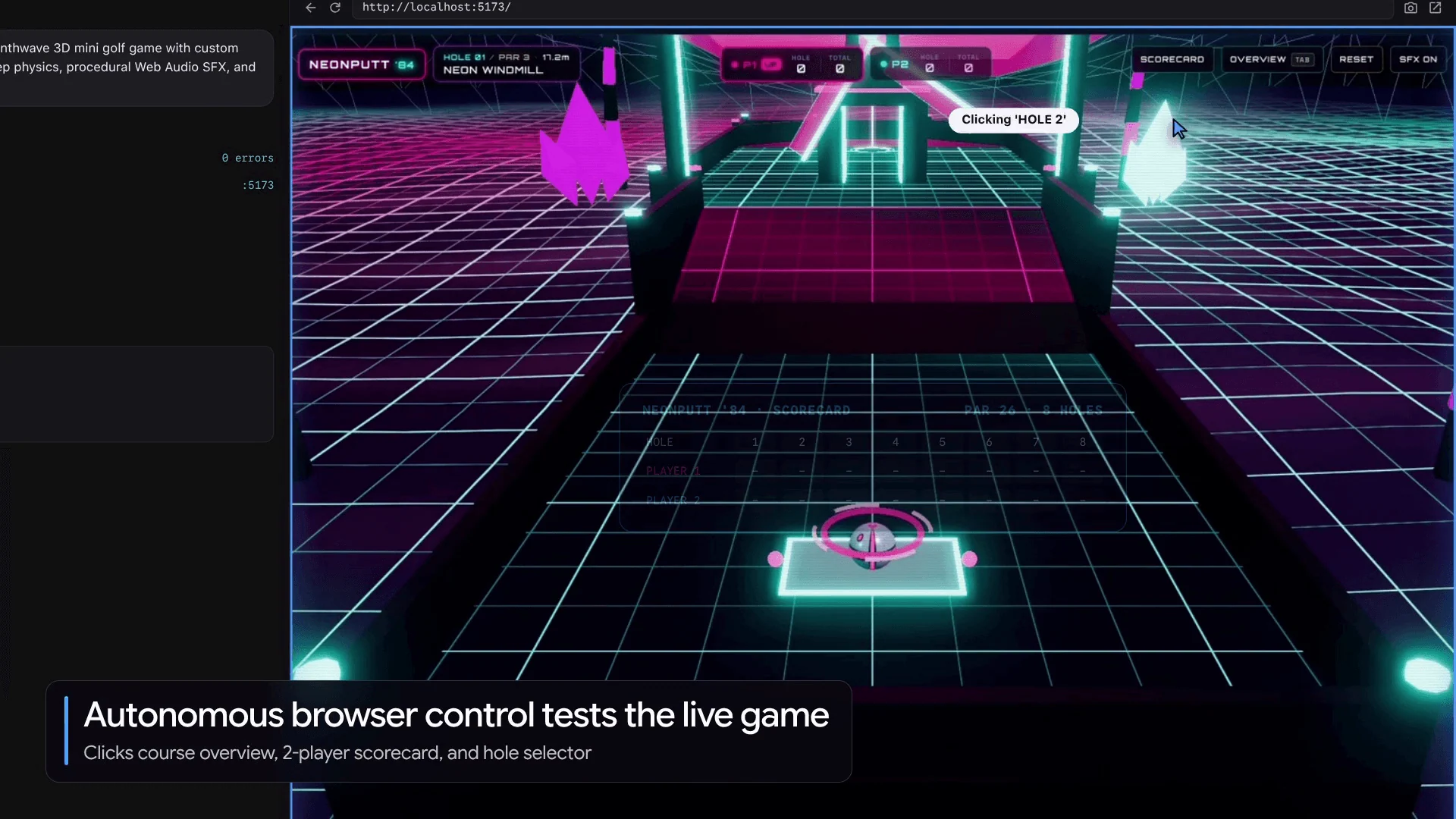
In the Antigravity example, Neon uses /swarm to build a multi-level, two-player game. Google says it runs in the built-in browser while the agent takes the second player’s role. The NeonPutt preview shows a mini-golf course, a two-player scorecard and the browser selecting a hole. Antigravity demonstration
Google’s main announcement also describes a first-person WebGL2 ski simulator built on Mont Blanc and Chamonix elevation terrain. It combines terrain rendering, ski movement and spatial audio in a browser project. For a smaller prototype, a useful starting brief would specify one slope or course, the controls, and the win or restart conditions before adding more levels. Ski simulator example

Select Neon directly or pair it with Hydrogen
Antigravity offers Low, Medium, High and Extra thinking levels for Neon, with High selected by default. Extra corresponds to xhigh in the CLI. Selecting Neon directly lets you choose that depth; Orchestrator (Neon) uses a fixed configuration, with Neon planning and reviewing while Hydrogen handles edits, builds and tests. Model selection
Neon is available with Google AI Ultra and eligible Google AI Pro access; Pro trial eligibility depends on the device offer. Free and Plus plans do not include it. Antigravity’s documented Neon context limit is up to 512K tokens. Plans and limits
Check the separate API budget
The stable API ID is gemini-4-neon. Its 1,048,576-token window is shared by input, thinking and output. Default synchronous output is capped at 65,536 tokens; longer output needs the documented long-decode path. API model limits
The API has no free tier for Neon. Standard pricing is $3 per million input tokens, $0.15 per million cached input tokens, and $15 per million output tokens, including thinking. The cache discount applies to implicit cache hits; explicit caching is unsupported. These API prices are separate from Antigravity plan quotas. API pricing
Continue with Prototyping & Coding and Testing & Optimization for related game-development workflows.
Sources (6)
Based on Google’s public announcements, documentation and original demonstration media. No sponsorship or affiliate links.