Repository research and multi-file implementation
It can trace an unfamiliar subsystem, identify dependencies, propose a plan, edit related files, and use repository context instead of relying only on pasted snippets.
O01O02O03O04You can start making a game before you can code: Codex can turn a clear brief into a playable build and iterate with you, while programming and engineering judgment become more valuable as scope and release stakes rise.
PRODUCT OVERVIEW
Codex changes the minimum skill needed to begin. A user can describe the rules and desired feel in ordinary language, let the agent create and run the project, try the result, and ask for corrections without hand-writing every line. Browser games are the clearest route to a first playable version, while templates and editor bridges can extend the same loop to game engines. Coding knowledge and engineering intuition improve control, diagnosis, and maintenance, but they should not be mistaken for admission requirements.
Codex is OpenAI's codebase agent across the ChatGPT desktop app, CLI, IDE extension, and cloud workflows. With permission, it can inspect a repository, explain unfamiliar code, plan a change, edit multiple files, run terminal commands, builds, and tests, inspect Git state and diffs, and continue after failures. Local branches or worktrees and isolated cloud environments can make changes easier to review and recover, but isolation does not make the code correct.
For game development, its most direct surface is source code and other machine-readable project data. OpenAI publishes a complete browser-game workflow covering a brief, PLAN.md, implementation, browser and Playwright checks, visual inspection, and deployment. Unity, Unreal, and Godot add a different layer: scenes, transforms, animation, Blueprint graphs, binary assets, editor state, feel, and real player paths need a dependable bridge or a developer inside the engine. Codex can help build the change; it should not be the only party deciding that the game works.
At the checked date, Codex is available through ChatGPT Free, Go, Plus, Pro, Business, Edu, and Enterprise plans, and through an API-key route. Plan limits, available models, cloud integrations, credits, and organization controls differ. The API-key route is separately metered and does not include every ChatGPT cloud integration.
It can trace an unfamiliar subsystem, identify dependencies, propose a plan, edit related files, and use repository context instead of relying only on pasted snippets.
O01O02O03O04With permission, Codex can run project commands, consume compiler and test feedback, revise an implementation, then return a reviewable diff through local or cloud Git workflows.
O01O04O05O06The work can start from a local terminal, editor context, the desktop app, or an isolated cloud task. Exact models, limits, tools, and integrations depend on the route and account.
O01O02O03O04O07OpenAI's game workflow explicitly combines planning and implementation with live-browser interaction, deterministic checks, Playwright, screenshots, visual review, and deployment validation.
O13INTERFACE & EXAMPLES
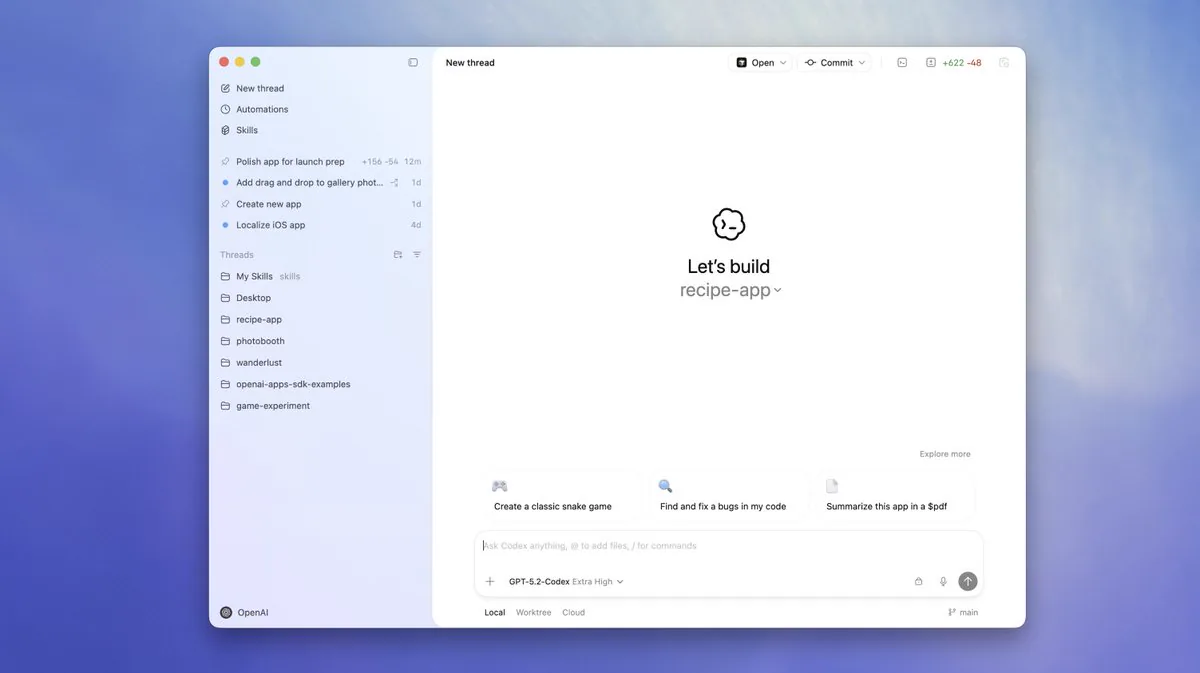
OpenAI's official article shows the Codex desktop workspace with project threads and a new-task composer.
This review covers Codex for beginner-directed browser prototypes, small games, and supervised work in existing game repositories. It does not rank coding agents, guarantee that any beginner will finish a game, test current model quality, or claim native, production-ready control of Unity, Unreal Engine, or Godot.
Beginner scope: A small browser game in the desktop app, not an existing large engine project.
Agent scope: Delegate repository coding tasks and collect their results.
Confidence: learning Medium · Agent Medium
These are independent editorial judgments, not an overall score or a claim of hands-on agent integration testing.
KEY FINDINGS
Official documentation supports repository inspection, planning, multi-file edits, terminal commands, builds, tests, Git review, and local or cloud execution. These are product capabilities—not proof that a particular implementation is correct.
O01O02O03O04O05O06OpenAI demonstrates Codex taking a browser game from a brief through planning, implementation, live-browser interaction, visual review, and deployment; a Unity discussion describes a non-developer using AI for prototypes and vertical slices. Together, these records support a materially lower entry barrier: a user can direct and judge a first playable loop without hand-writing every line. They do not prove effortless success—the official workflow is labeled intermediate, and complex projects still expose architecture and engine gaps.
O13U02U09Across Unity, Godot, and Unreal reports, users describe strong results for source systems, errors, migrations, and constrained logic alongside failures in vague architecture, transforms, animation, 3D work, and whole-project ambition. These records are not comparable enough for a success rate, but they consistently separate bounded code work from open-ended game production.
U01U02U04U05U06U07OpenAI's workflow joins planning, implementation, deterministic checks, live-browser interaction, screenshots, visual review, and deployment. An independent project uses a similar pattern of structured blueprints, validation, and human review. This supports the workflow—not a claim of one-shot quality.
O13U09Reading text files does not automatically reveal the correct scene transform, Blueprint graph, animation pose, asset reference, runtime visual state, feel, or player path. MCP servers, plugins, logs, screenshots, and editor tools can extend visibility, but they add setup and reliability dependencies of their own.
U01U03U04U05U07A build and an automated test can cover technical contracts while missing visuals, input flow, animation, random states, feel, performance, and the real player critical path. One Unity session report shows an agent claiming completion without the runtime evidence required by the repository rules.
O13U01U02U04U08U09AGENTS.md, narrow tasks, branches, worktrees, sandboxes, and approval rules make work easier to constrain, review, and recover. Context competition and environment-specific failures still occur, so important constraints must be restated and verified against actual behavior.
O05O06O09O10U02U08U10U11Plan prices, credits, tokens, messages, commits, and code lines do not reveal whether usable work was delivered. Compare all model, review, rework, CI, bridge, and integration cost with tasks that pass build, tests, diff review, and the necessary game checks.
O07O08U06U12EDITORIAL VERDICT
Codex can provide substantial help before a user knows how to program. OpenAI's official workflow takes a browser-game brief through planning, implementation, live-browser testing, visual review, and deployment; independent records also describe non-developers using AI to reach prototypes and vertical slices. If you can explain the rules, try the game, notice mismatches, and keep iterating, a first playable version is a realistic use—not merely a coding demo. Programming fundamentals, Git, tests, and engineering intuition are accelerators and safety nets rather than starting prerequisites. They become increasingly important when the game moves beyond a small prototype into complex engine state, architecture, performance, security, maintenance, or public release.
BETTER FIT
POORER FIT
WORKFLOW FIT
Describe the player's goal, controls, win and loss rules, visual references, and what should happen in the first few minutes. Ask Codex for a simple plan and plain-language explanations before it builds.
Let Codex implement one visible change, run the project checks, and explain what changed. Play that version before requesting the next mechanic or polish pass.
After automated checks, run the target game and verify controls, scenes, references, UI, visuals, animation, random states, performance, and critical player paths.
Record model route, credits or API spend, elapsed time, human time, retries, rejected approaches, regressions, bridge costs, and final acceptance, then compare with a similar manual baseline.
RECOMMENDED WORKFLOW
Three playable debugging exercises show how to describe a fault, limit an AI repair, check the result and recover a working version. Includes broken and fixed examples, six screenshots, templates and source.
SHORTEST RESPONSIBLE PATH
This is a low-risk starting workflow synthesized from the evidence.
Choose a one-room or one-mechanic game that can become playable quickly; write the controls, objective, win and loss states, and a few visual references in ordinary language.
For the easiest feedback loop, start with a browser game or a small engine template. Create a Git checkpoint or backup—you do not need Git mastery, but you do need a way back.
Ask Codex for a short plan and a first playable version. Have it explain unfamiliar terms and list exactly how to launch the game.
Require the normal build, static checks, and automated tests, but do not treat green output or the agent's own summary as completion.
Play it yourself. Report concrete observations—what you clicked, what appeared, what felt wrong, and what you expected—and iterate one change at a time.
If you cannot assess the code, get experienced review before adding accounts, payments, networking, sensitive data, complex dependencies, or preparing a public release.
Record credits or API spend, total elapsed time, human effort, retries, rejected solutions, regressions, and whether the task was finally accepted.
PRICING & RIGHTS
Pricing and terms last checked: Aug 21, 2026
One accepted task has passed the project build, relevant automated checks, human diff review, and any necessary browser, play, visual, scene, asset, performance, and critical-path checks.
O07O08U12Transparent arithmetic for 200k uncached input + 500k cached input + 20k output at the checked rates. It is not a measured game task, and the three models are not assumed to produce equal quality.
If a task needs three attempts with the same token mix, the nominal model bill triples before review, tools, CI, bridges, and human rework. Real attempts rarely have identical size or acceptance probability.
Five-hour message ranges and weekly limits are not stable allocations of features, fixes, tokens, or accepted tasks. A message may touch one function or run a long, tool-heavy workflow.
Actual accepted-task cost = (allocated subscription cost or API spend + human planning, review, debugging, playtesting, and rework + CI, browser, MCP, bridge, and third-party fees) ÷ tasks finally accepted. Track failed tasks and maintenance too; this page does not claim a typical dollar price per feature.
The checked official documentation establishes that API data is not used to train OpenAI models by default unless the customer opts in, and the pricing page says Business data is not used for training by default. It does not provide enough mapped evidence here to make a blanket claim about every personal-plan training setting, output ownership, commercial-use rights, confidentiality, copyright, patents, or third-party code licenses. Check the active account settings, controlling contract, and dependency licenses before sensitive or commercial use. This is not legal advice.
Prices, limits, credits, models, default behavior, clients, feature maturity, data controls, and integrations change quickly. Recheck the current pricing, account configuration, contract, permissions, network policy, and engine bridge before purchase or production use.
PRODUCTION RISKS
Generated code can compile, pass incomplete tests, or look plausible while violating architecture, edge cases, performance, security, or maintainability. Human review and project-specific acceptance remain mandatory.
U02U06U08Text access does not automatically reveal scene state, Blueprint graphs, binary references, visual defects, feel, or every player path. Bridges add reach but also synchronization, setup, permission, and reliability dependencies.
U01U03U04U05U07U08Repository instructions, pasted context, long sessions, model changes, client versions, sandboxes, extensions, and tools can interact in unexpected ways. Record the environment and keep recoverable checkpoints.
O14O15U10U11Sandboxing and approvals reduce some command risk but do not remove responsibility for secrets, uploaded code, internet access, prompt injection, malicious dependencies, plugins, MCP servers, or licenses.
O09O10O11O12A lower nominal model price can be erased by more attempts, longer output, review burden, regressions, CI, bridge failures, or maintenance. Keep actual bills and accepted-task records rather than relying only on the usage panel.
O07O08U06U12NOT VERIFIED
RESEARCH METHOD
Research-reviewed from public evidence. We checked 15 official OpenAI documentation pages and coded 12 independent records across four source environments: Unity Discussions, Reddit, the OpenAI Developer Community, and GitHub Issues. Nine platform or site groups were searched; Godot Forum, Epic Developer Community, GameDev.net, and Hacker News produced no usable direct record in this pass, while Lobsters produced general agent-workflow discussion without clear Codex attribution. Reddit contributes four of 12 records (33.3%); vendor material is not counted as user evidence, two vendor-hosted community posts remain labeled as user reports, and conflicting positive and negative reports are retained. Confidence is medium: repository and validation boundaries recur across platforms, while current-model game outcomes and quantitative accepted-task cost remain thin.
Official description of local repository inspection, file edits, commands, builds, tests, and interactive approvals.
Official IDE workflow, including editor context, selected code, local changes, and task handoff.
Official desktop surface for projects, files, integrated terminals, browser work, long tasks, and review.
Official cloud-agent overview for isolated environments, repository tasks, checks, and returned diffs.
Local Git, diff, review, staging, revert, commit, push, pull-request, and worktree workflow.
Cloud checkout, setup, container execution, AGENTS.md instructions, checks, and diff return behavior.
Current ChatGPT plan prices, Codex availability, shared usage, five-hour message ranges, weekly limits, credits, and usage variability.
Current GPT-5.6 Sol, Terra, and Luna API and ChatGPT-credit rates used for the transparent nominal examples.
Operating-system sandbox boundaries and how local commands are constrained.
Approval rules, permission decisions, and the security responsibilities that remain with the user.
Default cloud-network posture, allowlisting options, and prompt-injection, exfiltration, dependency, and licensing risks.
API training defaults, abuse-monitoring retention, and eligible customer data-control options; it does not settle every personal-plan path.
Official workflow from a game brief and PLAN.md through implementation, browser inspection, Playwright checks, visual review, and deployment.
Official definitions for experimental, beta, and stable features used to limit permanence claims.
Rapidly changing models, clients, context behavior, browser features, plugins, and workflows.
A Unity thread reports repeated club-position and animation failures from screenshots; another user reports strong code systems but unreliable transforms and recommends editable calibration tools.
A first-person workflow supports prototyping and vertical slices, while replies stress local context, AGENTS.md, Git, play mode, integration tests, and smaller tasks.
A current integration thread lists MCP, CLI, permissions, compilation, logs, screenshots, profiler, editor UI, and build validation as separate setup and reliability concerns.
Conflicting Godot, Unity, Unreal, and algorithm reports: source and some editor tasks work for some users, complete-game reliability varies, and playtesting remains necessary. One reply discloses an affiliated Unreal guide.
A low-sample first-person report claims a one-week Unity-to-Godot port with a third-party MCP, without project-scale, version, test, or quality metrics.
A three-month failed game-engine project says Codex handled much routine code but could not rescue vague architecture, unfamiliar engine design, rendering, or spatial reasoning.
Users report strong UE5 C++, error, and source-control help, but also say default Blueprint creation, complex 3D work, rigging, and animation remain difficult and require expertise or bridges.
A Unity session report shows Codex ignoring project acceptance rules, treating a shell project error as the gate, and claiming completion without runtime player evidence.
An independent browser-game author uses Codex for prototyping, refactoring, debugging, structured stage blueprints, validation, and human review; the post promotes the author's own game.
An open, version-specific desktop issue reports that pasted context lost to AGENTS.md summarization was then incorrectly declared fully read.
An open Windows 11 issue with a minimal reproduction reports that sandboxed subprocesses hang while the same shells work outside the sandbox.
An open usage-display issue reports a mismatch between the desktop panel and backend usage state, reinforcing the need to keep actual billing records.
DISCLOSURE
Independent editorial research. MakeGameWithAI has no affiliate link, sponsorship, vendor-provided account, free credits, equipment, interview, or technical support for this review. The project owner has used Codex, but that experience is background and is not counted as first-party validation. U04 includes an affiliated-guide disclosure, U09 promotes the author's own game, and U08–U09 are hosted on an OpenAI community platform; these records are labeled, down-weighted, and cross-checked. Owner Review was completed before publication, and the beginner-access framing was reviewed again on Aug 24, 2026.
This public research review will be revisited when pricing, terms, product versions, or material new evidence changes.
The September 30 launch connects backend integration and live operations to Codex. SDK 1.0.0 targets Unity 6 and later; the service is currently free during beta.
Read article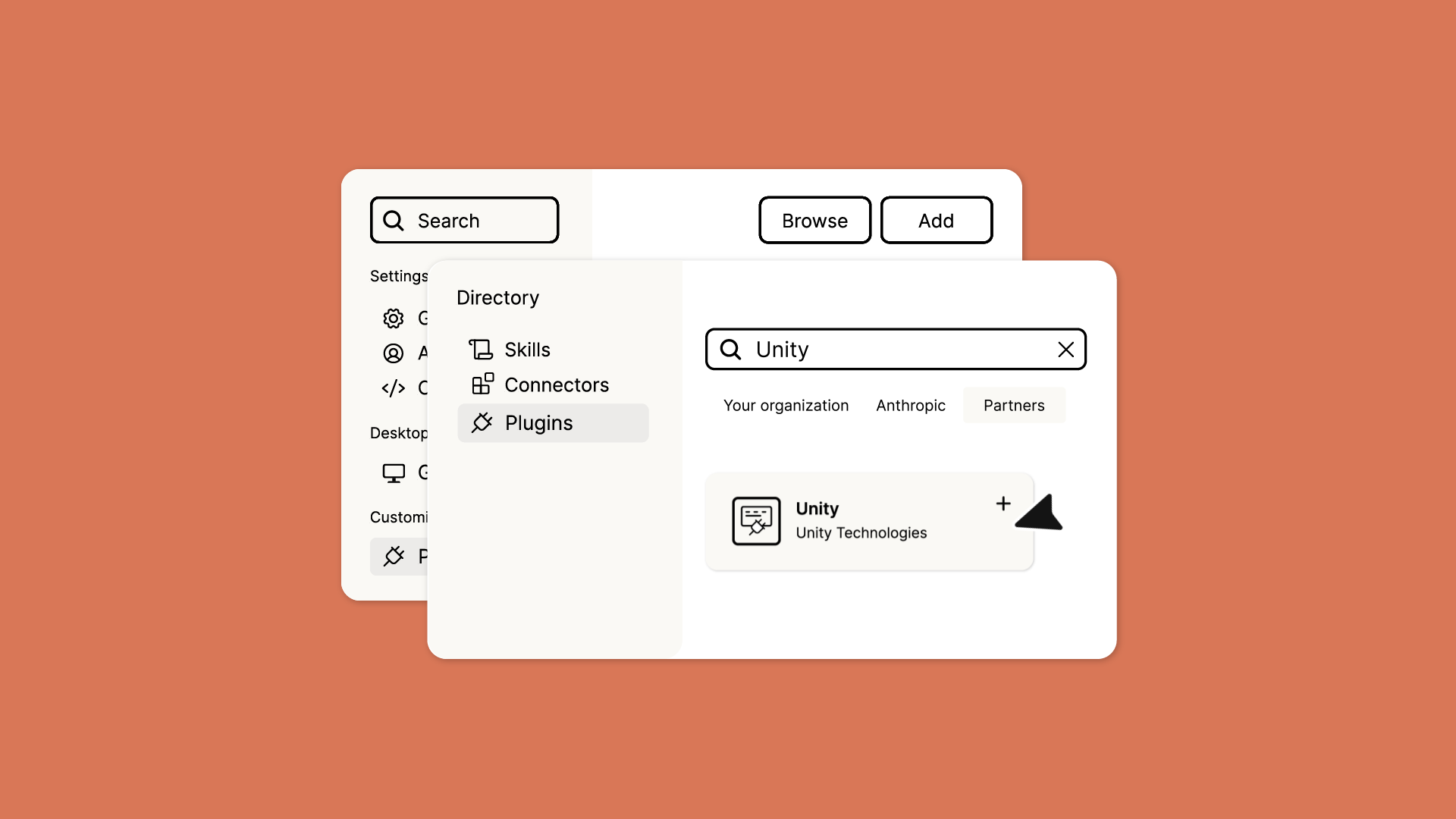
Unity has packaged its engine guidance into an official agent plugin. The September 9 announcement focused on Claude Code, while Unity's current documentation and repository now provide a Codex installation path; live Editor control still requires the Unity CLI and Pipeline package.
Read article